

Sorensen Lab’s Amy Benedetto wins Eli Lilly/Taylor Fellowship in Chemistry
Third-year graduate student Amy Benedetto has been awarded the 2025-2026 Eli Lilly-Edward C. Taylor Fellowship in Chemistry.
The award is given each year to an outstanding post-generals graduate student in the fields of biochemistry and/or organic chemistry. Benedetto is a member of the Sorensen Lab, where she is lauded for both her research and her leadership skills.
“I am so overwhelmed and grateful. It means a lot that the selection committee would recognize how hard I’ve worked,” said Benedetto. “Especially in today’s climate when fellowships like this can help you cover your graduate school expenses, I was so thankful to receive this. And it really helps push forward our lab work.”
Her research focuses on the synthesis of complex steroids with potential applications to human health.
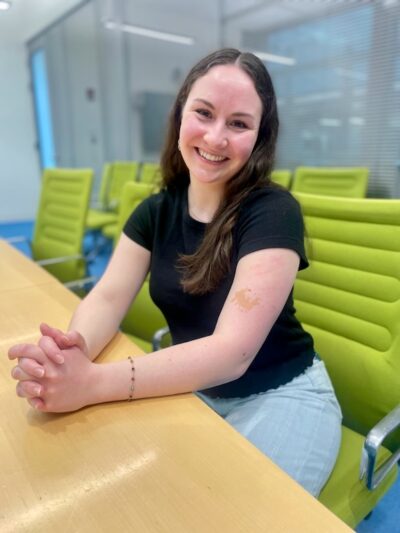
Third-year graduate student Amy Benedetto, the recipient of this year’s Eli Lilly-Edward C. Taylor Fellowship in Chemistry.
Benedetto’s mentor, Arthur Allen Patchett Professor in Organic Chemistry Erik Sorensen, said she is an outstanding mentor for younger or less experienced students in the lab.
“It is both a joy and privilege to have Amy Benedetto as a graduate student in my laboratory. She is both serious and sharply focused on her development as an organic chemist. She also cares for her colleagues and insists that we maintain the highest of standards in our work in chemistry,” said Sorensen.
“She is a very thoughtful chemist and always eager to perform experiments. Amy is so reliable that she has been our lab manager since the spring of her first year. I could not be happier with her performances as a student in our program and in my laboratory.”
Benedetto is currently focused on two projects in the Sorensen Lab, including the semi-synthesis of a steroidal alkaloid.
“Typical steroids have four rings in their core skeleton, but the ones I am working on have additional rings, thus requiring more intricate syntheses,” said Benedetto. “The first one I started working on is called diploclidine, which possesses a fully substituted pyridine ring. Nothing like it has ever been made before, and we have hope for its biological activity. So I’m working on finishing that project up. Since it hasn’t been tested, hopefully I’ll be able to make enough to run it through some screens to see if it has any activity.”
In addition, Benedetto is participating in the lab’s group project on an even more complicated steroid from the taccolonolide family, a unique class of microtubule stabilizing natural products with proven biological activity, most promisingly against cancer.
“The molecule is so challenging due to its oxygenation patterns and stereochemistry that it’s never been synthesized before,” she added. “We are working very hard on that project via multiple strategies.”
Benedetto grew up in Amherst, Massachusetts, just across the street from Amherst College where both of her parents are mathematics professors. She received her A.B. in Chemical and Physical Biology from Harvard University, graduating magna cum laude in 2023, working in antibiotic synthesis under the mentorship of Andrew Myers. She excelled there as a teaching assistant for Myers’ course in undergraduate organic chemistry. She was also an undergraduate researcher at the Harvard Medical School. Benedetto has received a National Science Foundation Graduate Research Fellowship for her work that gave rise to the reported structure of diploclidine.
When not in the lab, Benedetto enjoys dancing, loves to read, and also tackles the range of New York Times puzzles as often as she has time. She is also a Princeton Outreach Volunteer, helping high school students and assisting with chemistry-based public library science demonstrations.
Benedetto is hoping to go into an industry job as a discovery chemist once she completes her Ph.D. at Princeton Chemistry.