

Xuezhi Bian Wins Global Physics Jankunas award
Postdoctoral Fellow Xuezhi Bian of the Chemistry in Solution and at Interfaces (CSI) center has won the prestigious Justin Jankunas Doctoral Dissertation Award in Chemical Physics at the American Physical Society’s Global Physics Summit in Colorado.
Bian won the annual award for his talk, A phase-space electronic structure framework to nonadiabatic dynamics and spin chemistry, research that he and colleagues developed during his Ph.D. with the Joseph Subotnik Group. He is now being mentored for his postdoc by Roberto Car, the Ralph W. *31 Dornte Professor in Chemistry. The award includes a stipend and travel coverage for the summit.
“I was absolutely overwhelmed,” said Bian, who gave back-to-back talks at the summit. “I had to run to the second talk. But I made it. Now, I am just really glad that our work is being appreciated. I’m quite happy about that.” He added the award is timely because the research on which it is based is gaining broader acceptance among physicists, and the award will generate new visibility.
Bian is jointly advised by Emily Carter, the Gerhard R. Andlinger Professor in Energy and the Environment and Professor of Mechanical and Aerospace Engineering, and a P.I. with CSI.
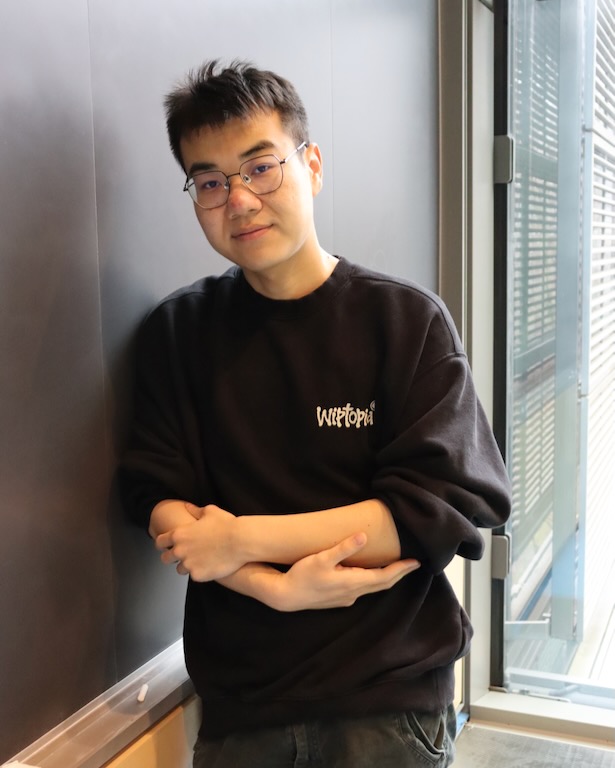
Postdoctoral Fellow Xuezhi Bian at Frick Lab.
“This is a remarkable honor in our field that strives to recognize a top graduating scholar who, during their Ph.D. training, has pushed forward paradigm-shifting work in physical chemistry and chemical physics,” said Assistant Professor of Chemisry Alice Kunin, an early career member of the Division of Chemical Physics Executive Committee. “Each year, the submission pool is a remarkably competitive group. To win, a candidate must not only showcase a major new development in the field, but also present a deep, comprehensive body of work and communicate these advancements.
“The selection committee was very impressed by Xuezhi’s presentation of his work developing a completely new framework for understanding coupled nuclear-electronic dynamics entirely outside of the standard Born-Oppenheimer picture.”
Bian’s research, still in progress within the Subotnik Group, seeks to transcend the limitations of the Born-Oppenheimer Theory, a foundational idea scientists have used for 99 years to apprehend the complexity of molecular movement by assuming a fixed position for the nuclei. The theory does not account for how the movement of electrons leads to an exchange of momentum with the nuclei.
Bian’s approach improves our ability to draw greater information from these systems.
“You lose information with Born-Oppenheimer because it assumes that the nuclei are fixed. Our theory, which is called phase-space electronic structure theory, is trying to solve this problem,” said Bian. “We not only want to take into account what is the coordinate of the molecule but also how the molecule moves, the momentum information of that molecule. To fully understand the system, I think it’s obvious that you have to understand not only the molecule’s geometry but also how it moves.
“So, first we wrote several papers to show that our approach works better than the traditional approximation. And then we started to apply our approach to simple systems to demonstrate that we get much more information than the traditional approximation,” he explained. “I think this is a fascinating direction. Our phase-space electronic structure theory opens up new avenues to understand experiments that are hard to explain within the Born–Oppenheimer framework, particularly intriguing effects like chiral-induced spin selectivity. But we’re still some steps away from a full understanding.”
Princeton Chemistry had a second finalist in the Global Physics competition. Linqing Pen, now a postdoc with the Subotnik Group, was a runner up for her talk, Practical Electronic Structure Methods for Strongly Correlated Electron Simulations.
“The Jankunas award is the highest honor that the Division of Chemical Physics can give to a postdoc for their graduate thesis. It’s a big deal,” said Joseph Subotnik, David B. Jones Professor of Chemistry. “Xuezhi’s thesis really opened up a field of study: a phase-space view of electronic structure theory to get around the standard framework that has limited chemists for 99 years. This was a huge honor for him.
“It’s very, very cool that Princeton Chemistry had two postdocs among the finalists,” Subotnik added. “The department should be very proud.”
Bian received his undergraduate degree in chemistry from Wuhan University in China. He was enrolled in a summer research program at the University of California, Berkeley, before applying to do his graduate work with Subotnik, then a professor at the University of Pennsylvania. Bian joined CSI for his postdoc work in October of 2024.