

Summer Series: Papers We Love with Leslie Schoop
The Princeton Department of Chemistry publishes nearly 300 journal papers each year. Some of them make quite a stir. Others glide along under the radar with citations that ebb and flow based on whether a particular field is in play. Still others lodge themselves in their authors’ minds as representative of a lab’s greater mission.
This summer, we’re going to highlight papers in this third group; the ones that were magical, even formative in a faculty member’s research program.
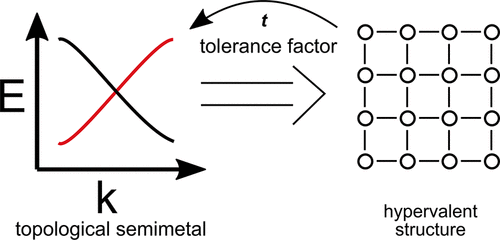
Like this one from Professor of Chemistry Leslie Schoop: The Role of Delocalized Chemical Bonding in Square-Net-Based Topological Semimetals, which ran in the Journal of the American Chemical Society (JACS) in March of 2020, selected for the JACS Young Investigators Issue. The authors were: Sebastian Klemenz, Aurland Hay, Samuel Teicher, Andreas Topp, Jennifer Cano, and Leslie Schoop.
Enjoy our brief Q&A below.
Why is this paper important to your lab?
This paper is the clearest statement of what my group is really about. We use the logic of chemistry, bonding and electron counting, to predict new quantum materials rather than searching for them one compound at a time. A few years earlier, I had helped identify ZrSiS, an air-stable, non-toxic topological semimetal that became a workhorse for the whole field. This paper is where we stopped treating materials like ZrSiS as lucky finds and wrote down the chemical rule behind them. That move, from a single material to a predictive principle, is the idea the lab is built on, and it is the template we have reused ever since.
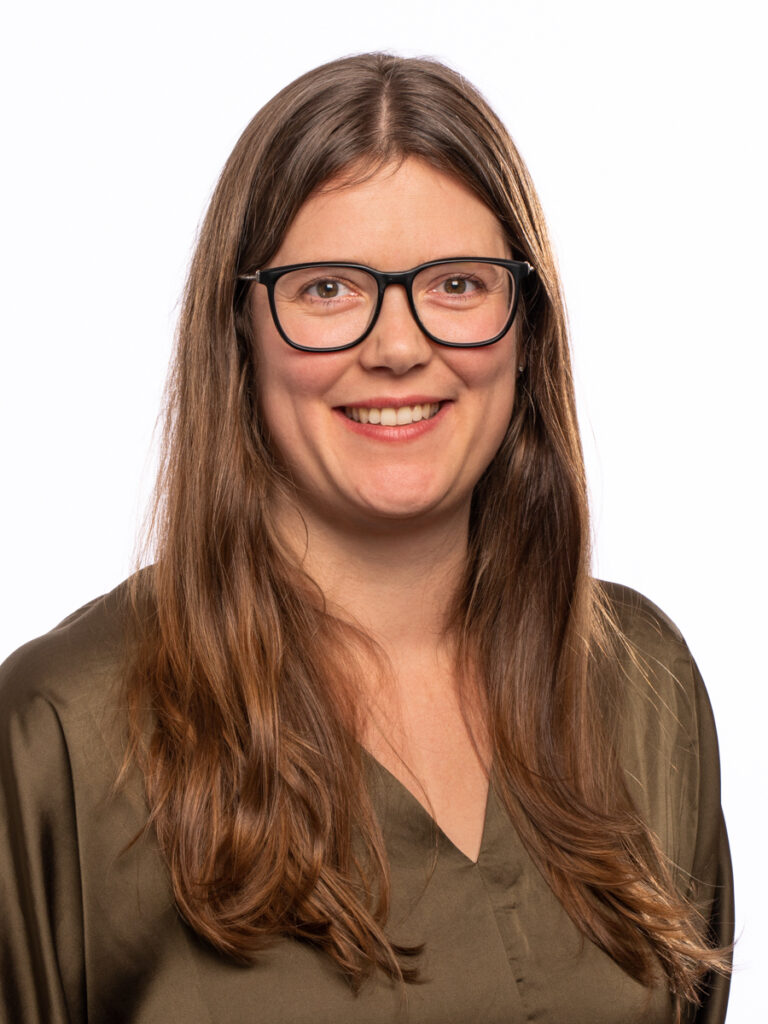
Professor of Chemistry Leslie Schoop
What was the takeaway message?
The takeaway is that you do not need a supercomputer to find a topological material. We showed that a simple chemical heuristic, based on how far apart the atoms sit in a square-net layer and the character of the bonding within it, predicts whether a square-net compound will host the unusual electronic states we are after. Applying that rule by hand, we identified more than 300 candidate materials, including alloys, solid solutions, and compounds with vacancies that standard computational screening tends to miss.
What question were you trying to answer with this research?
We kept noticing that square-net materials, with ZrSiS as the famous example, produced clean topological electronic structures, where electrons can move as if they were fast, massless particles, far more often than coincidence would explain. So we asked a chemist’s question: Why? Our thinking was inspired by Roald Hoffmann, in particular his work with Garegin Papoian in Angewandte Chemie that linked hypervalent bonding to the electron counts of square nets and other extended networks. Building on that picture, we pinned down how that delocalized bonding in a square net forces the topological states, and with it we had a way to point to promising new materials before anyone went into the lab to make them.
How does this paper contribute to the broader field?
It reframes the search for topological materials as a chemistry problem rather than a purely computational one. That lets chemists design candidates directly and reach materials that database searches cannot, including magnetic and disordered ones. Just as important, the way of thinking turned out to be general. We have since applied the same chemical logic to other atomic lattices: kagome nets (Jovanovic and Schoop, JACS 2022, 144, 10978) and pyrochlores (Katmer et al., JACS 2025, 147, 18166), to predict the flat electronic bands that are now central to the search for new quantum phases. The kagome paper in particular has been cited more than 75 times and has become a common chemical reference as that area has grown. This square-net paper was the first chapter of that story.
This 2020 research was supported by the Arnold and Mabel Beckman Foundation through a Beckman Young Investigator grant awarded to Leslie Schoop.
**References mentioned above:**
Featured paper: S. Klemenz, A. K. Hay, S. M. L. Teicher, A. Topp, J. Cano, L. M. Schoop, *J. Am. Chem. Soc.* 2020, 142, 6350. https://pubs.acs.org/doi/10.1021/jacs.0c01227
Inspiration (hypervalent bonding in square nets): G. A. Papoian, R. Hoffmann, *Angew. Chem. Int. Ed.* 2000, 39, 2408. https://onlinelibrary.wiley.com/doi/10.1002/1521-3773(20000717)39:14%3C2408::AID-ANIE2408%3E3.0.CO;2-U
Kagome follow-up: M. Jovanovic, L. M. Schoop, *J. Am. Chem. Soc.* 2022, 144, 10978. https://pubs.acs.org/doi/10.1021/jacs.2c04183
Pyrochlore follow-up: F. Katmer, M. Jovanovic, J. Cano, L. Muechler, L. M. Schoop, *J. Am. Chem. Soc.* 2025, 147, 18166. https://pubs.acs.org/doi/10.1021/jacs.5c04593