

Tom Muir Selected a 2026 Edison Patent Awardee for Engineered Split Intein Technology
Tom Muir, the Van Zandt Williams Jr. Class of 1965 Professor of Chemistry, has been named a 2026 Edison Patent Awardee by the Research & Development Council of New Jersey.
The Edison Patent Award is New Jersey’s highest recognition for innovators, honoring exceptional inventors for over 40 years for the novelty, significance, and impact of their inventions.
Muir was selected in the Biotechnology category for his 2021 patent: “Split Inteins With Exceptional Splicing Activity,” (U.S. Patent No. 11,142,550 B2).
The invention is a consensus design approach to engineer split inteins—a class of proteins that act as a kind of glue, stitching together other proteins from disparate components—with enhanced stability, making them more robust than through any previous trans-splicing system.
Despite their broad appeal for a range of biotechnological applications, split inteins were historically limited in their use because the stitched molecules were neither stable nor efficient. The Muir Lab’s invention overcomes these practical drawbacks.
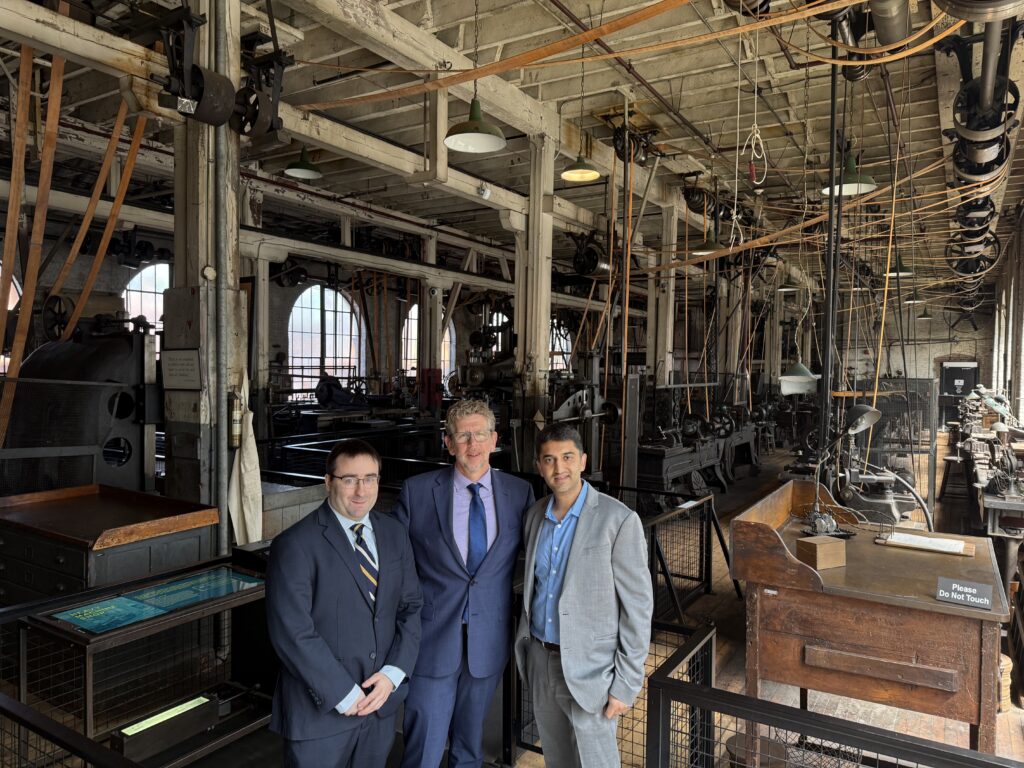
Muir Lab patent co-owners (left to right) Adam Stevens *18, Tom Muir, and Neel Shah at the Thomas Edison National Historical Park's Edison Lab in West Orange, NJ, where they were filmed as part of a video announcement for the November 2026 awards ceremony.
“Tom is a world-leading chemical biologist who has pioneered the chemistry of inteins for protein editing and protein splicing,” said Department Chair Paul Chirik. “It is rewarding to see his foundational work being translated into practice and recognition with the Edison Patent Award.”
The 2026 awards cohort was announced this week. It includes Princeton University Ning Lin, professor of Civil and Environmental Engineering.
“Every revolution begins with curiosity,” said Virginie Maillard, chair of the Council. “The inventors and leaders we recognize this year saw possibilities where others saw obstacles and imagined better solutions. Their work reminds us that innovation isn’t a single moment of inspiration. It’s the persistence to keep asking questions, testing ideas, and turning bold thinking into real-world impact. That spirit has defined New Jersey for generations, and it continues to shape our future.”
This marks the Department’s third Edison Patent Award in recent years. David MacMillan, the James S. McDonnell Distinguished University Professor of Chemistry, won it in 2022. And Jeffrey Schwartz, professor of chemistry emeritus, won it in 2023.
The Muir technology was first announced in a 2016 paper in the Journal of the American Chemical Society (JACS), Design of a Split Intein with Exceptional Protein Splicing Activity. It was authored by Adam Stevens, Zachary Brown, Neel Shah, Giridhar Sekar, David Cowburn, and Muir. Stevens and Shah are co-owners on the patent.
That paper was followed a year later by A promiscuous split intein with expanded protein engineering applications in the July 2017 issue of the Proceedings of the National Academy of Sciences (PNAS), authored by Stevens, Sekar, Shah, and Muir.
Molecular Stitching Technology
Muir’s invention offers a highly efficient molecular “stitching” technology, in which two separately delivered protein fragments can be brought together inside a target cell. There, split intein fragments catalyze the formation of a single, functional protein, according to nomination materials supplied by Princeton University. The technology is particularly powerful for genetic medicine because many therapeutically important genes are too large to fit within a single adeno-associated virus (AAV) vector, one of the most widely used delivery vehicles in gene therapy.
By allowing a large therapeutic protein to be encoded as two smaller components, delivered separately, and then reassembled through protein trans-splicing, the invention provides a path to treat diseases that have been difficult to reach.
The lab’s research began with Shah’s identification and characterization of several new natural split inteins and investigating what makes some of them “behave better than others.” When Stevens joined the lab, they together expanded on the research by engineering a souped-up intein.
The team used a technique called consensus protein design, with an alignment of naturally split inteins they predicted would have fast splicing activity based on the presence of the identified “accelerator” residues.
“This consensus fast (Cfa) intein exhibited both enhanced stability and activity,” said Stevens, now a professor at the University of Pennsylvania. “Some of the results we found most surprising were that Cfa expressed at exceptional yield and retained efficient splicing activity in up to 8 M urea (a chaotropic agent that unfolds most proteins at this concentration) and at temperatures up to 80 °C.”
Shah, now a professor at Columbia University, added: “Many academic labs use inteins as tools to construct proteins bearing all kinds of interesting modifications, or to manipulate protein function in live cells and organisms. The engineered inteins that Adam and I designed under Tom’s guidance have become mainstays for academic labs. Then, several companies have started to use these inteins toward various commercial applications.”
For example, the team’s patent was licensed to a spinout biotech company called SpliceBio. The genetic medicines company, which is based in Barcelona, is using the platform to develop the next generation of gene therapies. Currently, it has a product undergoing clinical trials in humans for a type of blindness called Stargardts Disease, an inherited eye disorder that causes vision loss in children and young adults.
Edison Patent honorees are selected by a team of R&D Council researchers who evaluate patents for applicability and socio-economic value, novelty, and commercial impact. At least a part of the technical or scientific work for all winning patents must be completed in New jersey.
The 47th Annual Edison Patent Awards ceremony will take place on Thursday, Nov. 19 at the Bell Works in Holmdel, New Jersey, where honorees will be introduced via a tribute film honoring their achievements. For more information on the Council, please click here.