

Kleiner Lab uses profiling platform on bacteria, identifies new bacterial RNA-modifying enzyme
In service of their mission to explore the relationship between RNA chemistry and biological processes, the Kleiner Lab deployed its activity-based profiling platform on common bacteria for the first time, proving its efficacy in bacterial systems and simultaneously identifying a new RNA-modifying enzyme unique to the model bacteria Bacillus subtilis.
The lab’s research advances our understanding of how RNA modifications in bacteria regulate fundamental cellular processes, which are poorly understood. It also opens the door to using the platform for future investigations into modifications installed by pathogenic bacteria, which could in turn lead to drug interventions for some of our most pernicious, disease-causing bacteria.
Journal: Proceedings of the National Academy of Sciences (PNAS)
Authors: Qais Jaber, Nathan Yu, Isao Masuda, Ya-Ming Hou, and Ralph Kleiner.
What this is: In this investigation, researchers looked at chemical modifications installed on RNA molecules by cellular enzymes. In order to probe the biological function of these modifications, the lab employed RNA-mediated Activity-Based Protein Profiling (RNABPP), which they introduced in 2021. RNABPP allows researchers to identify new RNA modifying enzymes in diverse biological contexts and infer the types of modifications they install.
This paper marks the first use of RNABPP on two prototypical Gram-negative and Gram-positive bacterial strains used in basic research: E. Coli and Bacillus subtilis.
Researchers were able to identify a new RNA-modifying enzyme in B. subtilis, which they named RlmS. They characterized its biochemical substrate, showing that it installs a single methyl group on the ribosomal 23S RNA, and identified its biological function, determining that it is important for the assembly of the B. subtilis ribosome.
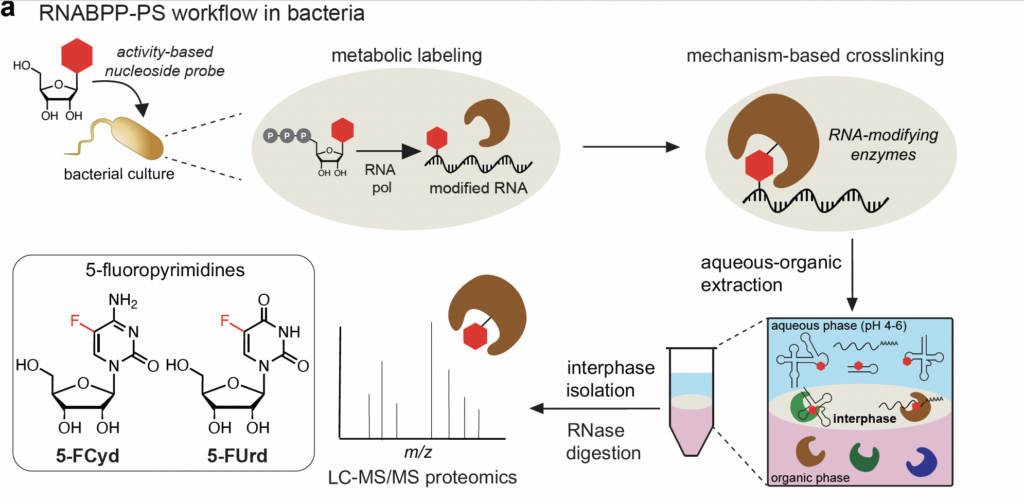
How researchers did it: Part of the work in this investigation was in adapting the RNABPP method for bacteria. Previously the approach had only been applied in mammalian cells. Due to differences in bacterial metabolism, cell structure, and bacterial RNA versus mammalian RNA, some innovation was necessary at the bench.
RNABPP applies principles of chemical reactivity to trap, or “crosslink,” RNA modifying enzymes and the RNA molecules they modify. It uses metabolic labeling with activity-based nucleosides, generating a mechanism-based complex between the RNA and the protein, and eventually—after enrichment steps of this complex—uses proteomics to identify the specific protein.
Comment from P.I. Ralph Kleiner, Associate Professor of Chemistry: “The efficacy of our RNABPP platform in bacteria is best demonstrated by our ability to identify known RNA-modifying enzymes in E. Coli and B. Subtilis. Finding something new, like RlmS, is more of the icing on the cake, but it’s also the reason that we apply new approaches to investigate old problems.
“There is a huge diversity of chemistry and biology present in the bacterial kingdom, and so far, we have only studied the tip of the iceberg. We are excited about applying our RNABPP approach in diverse bacteria to map the complement of RNA modifying enzymes and investigate their biological significance.
“It’s also worth mentioning that in pathogenic bacteria, bacterial RNA-modifying enzymes are involved in virulence and antibiotic drug resistance, so our work has therapeutic implications for the development of antibacterial drugs.”
Comment from Qais Jaber, Kleiner Lab postdoc: “This investigation is one step further in understanding posttranscriptional RNA modifications and the dynamics of this process. So for example, RlmS can install the modification in the ribosome, which is the cell machine that produces proteins. This modification is very important for the ribosome. We have shown that if you lose modification, the ribosome is not functional as the original. You have a defect in the ribosome that leads to defects in protein translation, and eventually lead to defects in the growth of the bacteria.
“My background as a Ph.D. was working for antibacterial, antifungal agents. So this drove me to start working on this project specifically in bacteria. My motivation was that we would, at the end, have a new platform that could work for a new drug for bacteria. Our hope is to first understand the mechanism, and then with full understanding we can maybe target that specific process.”
Funding: This research was supported by funding support from the National Science Foundation, (MCB-1942565 and MCB-2448119).