

Pair of Torquato Group papers devise “out of the box” algorithm to predict mosaic perovskites
In a pair of papers published over the past year, postdoctoral fellow Murray Skolnick and PI Salvatore Torquato introduced an algorithm that treats predicting layered mosaic perovskite structure as an effective hard-particle packing problem to model structure simply and quickly for large samples of materials.
It’s a creative and unconventional approach to simulations typically made with costly quantum chemical methods.
Together with Hemamala Karunadasa ’03 at Stanford University and colleagues at the University of Colorado Boulder, they applied the algorithm, called Lattice Adaptive Shrinking Cell (LASC), to a novel silver-chromium mosaic perovskite. The simulations helped explain its experimentally observed spin-glass behavior by predicting the formation of magnetic clusters.
The research revolves around a class of materials called layered mosaic halide perovskites, crystalline materials made from thin inorganic sheets where, within each sheet, distinct molecular building blocks occupy the metal sites of the crystal. Predicting and controlling that structure yields information about properties and could lead to chemical design.
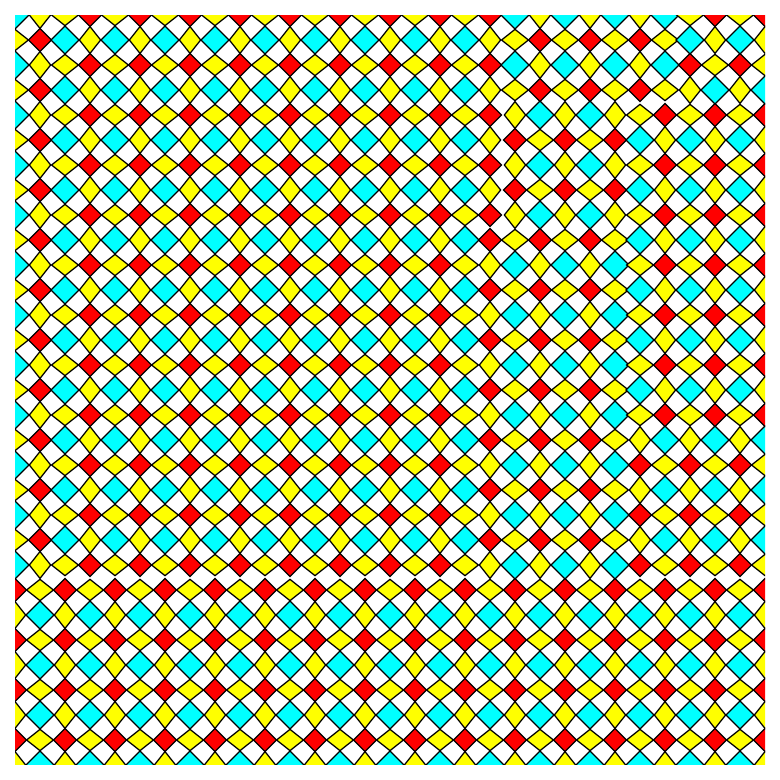
From the Journal of Chemical Physics, this image represents a LASC-simulated (CuIInIII)CuII2 mosaic perovskite.
It’s important research. Perovskites can produce a remarkable range of electronic, magnetic, and optical properties, depending on how the atoms and molecules are arranged within their structure. They offer great potential in technological applications from solar cells to lasers to tunable magnetic materials, and predicting how minute changes in structure affect properties will be important to these applications.
“A recurring theme in my research is trying to extract predictive structure from complicated, disordered systems,” said Skolnick, who received his doctorate under the Torquato Group and who recently completed his postdoctoral work in the Princeton Materials Institute. “I like taking a complex system, figuring out which details are essential and which can be stripped away, and then building a model that is simple enough to understand but powerful enough to accurately predict something new.
“I find it very satisfying when a small set of simple assumptions captures enough of the underlying system that complex, realistic behavior emerges without being explicitly built into the model.”
Torquato, the Lewis Bernard Professor of Natural Sciences and Professor of Chemistry, explained: “This is a type of tiling problem, but it’s also a packing problem. And that’s the interest that I had. It’s the physical, magnetic properties we uncovered that are really interesting.
“What drives the research from our point of view is that you can come up with an effective packing model that bypasses the need for full-blown quantum mechanical simulations, and yet accurately predicts its magnetic properties.”
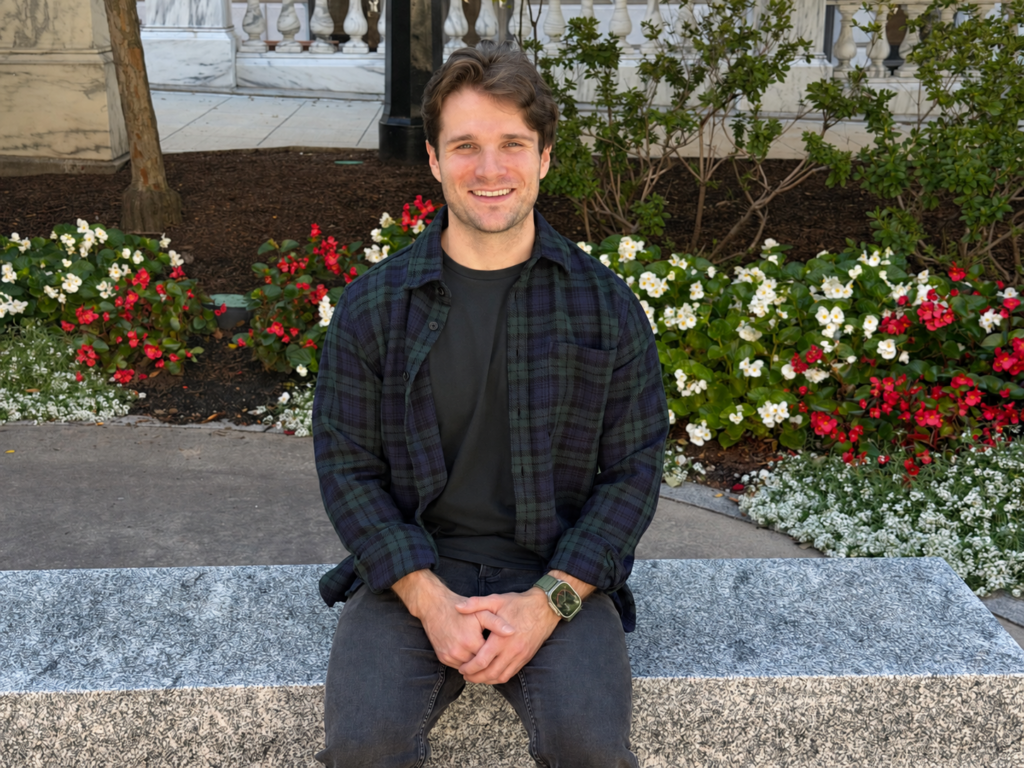
Murray Skolnick, co-author on the two perovskite papers.
The two papers are: Communication: Modeling layered mosaic perovskite alloy microstructures across length scales via a packing algorithm, in The Journal of Chemical Physics, November 2025; and, with Stanford and UC Boulder, A Mosaic Layered Halide-Perovskite Spin Glass: Mechanochemical Alloying of a Ferromagnet and a Paramagnet, in ACS Central Science, June 2026.
Princeton Assistant Professor of Chemistry Lilia Xie said the research is especially relevant to her own work. “We are very inspired by the beautiful work that’s been pioneered by various groups on hybrid inorganic-organic perovskites. This field has shown to great effect how design of the organic ‘spacers’ can be harnessed to template the structure and resulting optoelectronic properties of the inorganic motifs. Recent work and collaborations from Sal’s group take this a step further in showing that judicious tuning of the composition of the inorganic species in hybrid perovskites can give rise to emergent physical properties, including dynamic magnetic behavior.”
LASC and mosaic formation
The Torquato Group’s LASC algorithm captures a key structural constraint on mosaic formation: the metal-halide building blocks have to pack together without stretching or compressing chemical bonds too severely.
The project began with a 2022 visit to Princeton Chemistry by Karunadasa, who earned her undergraduate degree in chemistry at Princeton under Robert Cava. In conversation after a seminar presentation, she asked Torquato whether predicting the mosaics could be treated as a packing problem. He subsequently asked Skolnick to pursue the problem.
Drawing on his experience studying other packing problems, Skolnick approached the material’s structure as a question of how its building blocks fit together. He represented those molecular building blocks as geometric shapes and developed a computational approach to explore their possible arrangements. Mosaics generally contain three types of molecular building blocks, and their arrangement dictates the material’s properties.
Skolnick and Torquato used their previously developed mixing metric to measure how evenly the building blocks are distributed, from neighboring sites to larger regions of the material.
“For example, in the copper–indium material, strong mixing at the smallest length scales brings copper ions in different charge states into close proximity, enabling the electron transfer associated with its optical properties,” said Skolnick.
These were the optical effects that Karunadasa and colleagues had observed experimentally in a separate investigation into a copper-iridium system. The algorithm cast a strong light on what was happening in the structure, quantifying what is happening across different length scales.
The LASC algorithm provides a simple, cost-effective way of doing calculations that, if quantum mechanical methods were used, might realistically take hundreds of years. The research is also generalizable and could be applied, Skolnick said, to high-entropy allows and even metal-organic frameworks (MOFs). LASC can sweep through myriad parameter combinations and starting materials with different subunits and quantify the system.
“What made this project especially rewarding was the opportunity to connect our models of disordered materials directly with experiment, working closely with Julian Vigil (formerly of Stanford) who led much of the experimental work on the second paper,” said Skolnick. “My simulations and his experimental measurements constantly informed one another, which made the collaboration especially rewarding.”
Added Torquato: “You are able to bypass the need to do computationally expensive quantum mechanical calculations that get the right physics and you can run it on a laptop. We can explore the parameter space and the resulting structures cheaply and then extract the promising cases to synthesize them experimentally, rather than having to do a separate material synthesis every time you want to test it out.
“That’s the beauty of what we’ve done.”