

Anastassia Alexandrova
Catalytic Interfaces In And Out Of Equilibrium
Taylor Auditorium, Frick Chemistry Lab B02
Host: Marissa Weichman
Speaker Details:
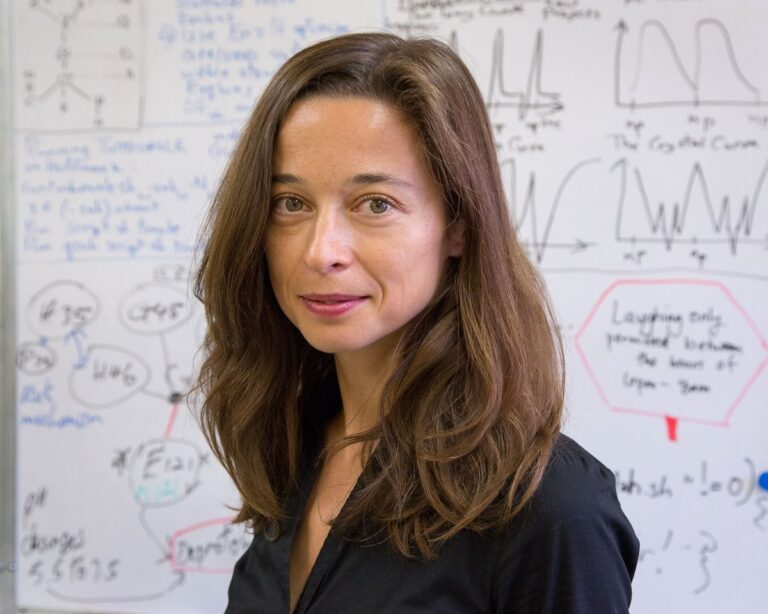
Professor of Chemistry
Charles W. Clifford Jr. Endowed Chair in Chemistry and Biochemistry
University of California, Los Angeles
Department of Chemistry and Biochemistry
Catalytic interfaces in reaction conditions undergo significant morphological changes, support high coverage with reagents and intermediates, and often undergo relentless structural and stoichiometric dynamics coupled to the reaction itself. Not surprisingly, successful catalyst formulations are usually found by chance. The talk will show grand canonical modeling of catalytic interfaces, maximally approaching reaction conditions. Simulations, and joint experimental studies, reveal interfacial fluxionality and ongoing dynamics. We reveal that statistical ensembles of many catalyst states (geometries and stoichiometries) are populated, and jointly control all catalyst properties, from activity and selectivity, to deactivation propensity, and operando spectral signatures. Swarms of reaction mechanisms are simultaneously in operation. Non-trivial kinetic effects represent a particular new challenge for modeling. Less stable, transient catalyst states can be driving all the catalysis. Furthermore, catalysis appears to reach phase boundaries in the steady state and exploit the associated instability to drive reactivity, often slipping into a non-equilibrium regime. Example systems illustrating this paradigm include supported cluster catalysis for dehydrogenation, and electrocatalysts for hydrogen evolution and CO2 reduction reactions.