

Anastassia Alexandrova
Catalytic Interfaces As Phase Boundaries Off Equilibrium
Taylor Auditorium, Frick Chemistry Lab B02
Host: Marissa Weichman
Speaker Details:
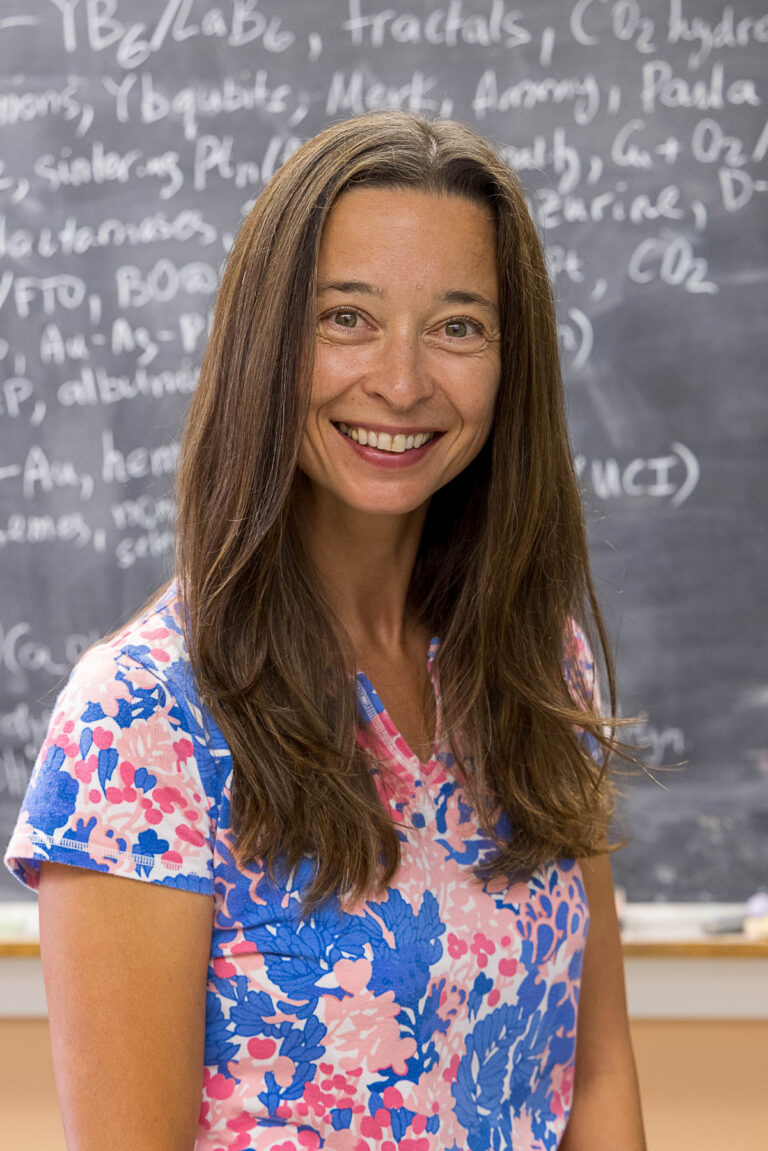
Charles W. Clifford Jr. Endowed Chair in Chemistry and Biochemistry
Department of Chemistry
University of California, Los Angeles
Traditionally, catalysts have been viewed as single stable phases of matter. Descriptors and models have been developed under this assumption. Through grand canonical simulations and in collaboration with experiment, we show that, instead, catalytic conditions place catalysts at phase boundaries. At those boundaries, catalysts have thermodynamic access to multiple phases that are often drastically different, e.g. metallic alloys and single metal nanoparticles supported on oxides can co-exist. The system then constantly attempts a phase transition, and fails to achieve it on the timescale of catalytic turnovers, thus being driven off-equilibrium. Metastable states contribute majority of the catalytic turnovers. A catalytically useful phase boundary can be stoichiometric, structural, or electronic. I will show how this theory applies across catalyst classes: thermal, electro-, nanoparticles, films, bulk, and topological alloys. Many strange experimental outcomes find a new explanation, in light of this realization. Phase boundaries and apparent lack of thermodynamic equilibrium present a serious challenge to theory. In summary, phase boundaries are where old catalysts operate, and where new catalysts need to be found.