

Odile Eisenstein
The Grignard Reaction: A 19th Century Discovery For a 21th Century Study
Taylor Auditorium, Frick Chemistry Lab B02
Host: Paul Chirik
Speaker Details:
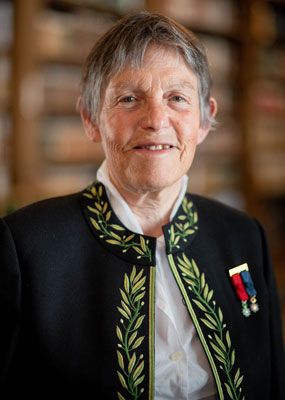
Professor of Chemistry
Department of Chemistry and Hylleraas Center for Quantum Molecular Sciences
ICGM Université de Montpellier, CNRS ENSCM Montpellier France, University of Oslo, Norway
In 1900, Victor Grignard published the discovery of organomagnesium reagents during his PhD work in the Comptes Rendus de l’Académie des Sciences—a breakthrough in carbon–carbon bond formation that earned him a PhD in 1901 and the 1912 Nobel Prize in Chemistry alongside Paul Sabatier. Over a century later, despite its foundational status in organic synthesis, the molecular behavior of the Grignard reagent remains notoriously elusive. As Dietmar Seyferth noted in 2009, Generally written as RMgX, the Grignard reagents in ethereal solution are more complicated than this simple formula indicates. Because these organomagnesium species exist in dynamic equilibria highly sensitive to solvent coordination, studying them under conditions that differ from in operando environments risks yielding biased propositions.
To represent these systems under “experimental conditions”, our collaborative team (with Michele Cascella and coworkers) leverages ab initio molecular dynamics (AIMD) and machine-learning interatomic potentials. In this lecture, I will discuss our progress in mapping the speciation and mechanism of organomagnesium and organolithium systems:
1) Solution Speciation in Ethereal Media: Characterizing the dynamic equilibrium and explicit solvation structure of in THF (1,2)
2) Mechanism & Pathway Selection: Deciphering the competitive pathways—nucleophilic addition versus single-electron transfer (SET)—and establishing that many Mg containing species are competent in the Grignard reaction (1,3)
3) Machine Learning Accelerated Exploration: Extending speciation dynamics across alkyl series (R = Me, Et, iPr, tBu) via machine-learned potentials trained on AIMD (DFT) studies. (4)
4) Non-Conventional Green Media: Modeling Grignard reactions within mixed deep eutectic solvents (DES)/THF solvents, motivated by Eva Hevia’s discovery that these media can sustain Grignard reactivity without rapid decomposition (5,6)
5) Extension to Organolithium Aggregates: Applying multiscale dynamics to resolve solvation, aggregation, and mixed-aggregate equilibria in organolithium systems ((LiX)4, (X = Cl, Br, I), (LiMe)4 and LiMe/LiCl mixtures) in TH. (7,8,9)
References
(1) M. Cascella, S. L. Bore, O. Eisenstein The fellowship of the Grignard: 21st century computational tools for hundred-year-old chemistry Chem. Science. 2025, 16, 8196
(2) R. Peltzer, O. Eisenstein, A. Nova, M. Cascella How Solvent Dynamics Controls the Schlenk Equilibrium of Grignard Reagents: A computational Study of CH3MgCl in tetrahydrofuran J. Phys. Chem. B 2017, 121, 4226
(3) R. Peltzer, J. Gauss, O. Eisenstein, M. Cascella The Grignard Reaction-Unravelling a Chemical Puzzle J. Am. Chem. Soc. 2020, 142, 2984
(4) M. Bortoli, S. L. Bore, O. Eisenstein, M. Cascella The influence of the organic residue and the solvent in the Schlenk equilibrium for Grignard reagents in THF. A molecular dynamics study with machine learning potentials J. Catalysis 2026, #116619
(5) I. Manasi, M. Bortoli, D.T. Bowron, M. Campana, O. S. Hammond, T. F. Headen, J. Hooton, E. Hevia, M. Cascella, O. Eisenstein, K. J. Edler Are Grignard Reactions in Deep Eutectic Solvents Interface-Driven? Angew. Chem. Int. Ed. 2025, 64, e202513649
(6) M. Bortoli, E. Hevia, O. Eisenstein, M. Cascella Enhancing Grignard reactions via anion borrowing in deep eutectic /organic biphasic media Submitted.
(7) M. de Giovanetti, S. H. H. Eliasson, A. C. Castro, O. Eisenstein, M. Cascella Morphological Plasticity of LiCl Clusters Interacting with Grignard Reagent in Tetrahydrofuran J. Am. Chem. Soc. 2023, 145, 16305
(8) M. de Giovanneti S. H. H. Eliasson, S. L. Bore, O. Eisenstein, M. Cascella Morphology of lithium halides in tetrahydrofuran from molecular dynamics with machine learning potentials Chem. Sci. 2024, 15, 20355
(9) M. de Giovanetti, S. H. H. Eliasson, M. Bortoli, S. L. Bore, O. Eisenstein, M. Cascella The multifaceted structural features of
MeLi and MeLi/LiCl in THF: A Computational Study of Aggregation and Dynamics To be submitted