Tianquan Lian
Electrode-Induction Effects and Plasmon-Driven mode-selective Adsorbate Excitation
Taylor Auditorium, Frick Chemistry Lab B02
Host: Alice Kunin
Speaker Details:

John H. and Margaret B. Fassitt Professor of Chemistry
Editor-in-Chief of The Journal of Chemical Physics
Department of Chemistry
The University of Pennsylvania
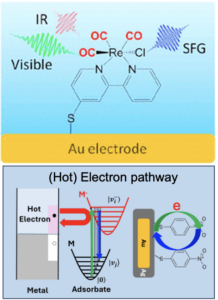
Attaching molecular catalysts on (photo-) electrodes offers a promising approach for modular and rational design of hybrid catalysts for (photo-) electrochemical transformations. The design and improvement of such hybrid catalysts require fundamental understanding of the structure and microenvironment of catalysts, interfacial field, and adsorbate-electrode interaction as well as their effects on adsorbate/catalysts excited state dynamics. To probe these electrode-adsorbate interactions at the molecular level, we have been developing and applying time-resolved vibrational sum frequency generation (VSFG) spectroscopy and surface enhanced Raman spectroscopy (SERS) as in situ interface specific/sensitive vibrational spectroscopic tools. In this talk, I will discuss two recent studies in this area. 1) Electro-induction effect. We have observed large electrochemical-Stark effect of adsorbed molecules and molecular CO2 reduction catalysts. Through combined experimental and theoretical studies, we show that the Stark-effect is dominated by through bond interaction of the electrode on the adsorbates (i.e. the electro-induction effect), and this result suggests a potential new approach for design and control of attached molecular catalysts. 2) Plasmon driven mode-selective adsorbate excitation. Using time-resolved-SERS, we show that for 4-nitrothiolphenol on Au nanoparticles, the excitation of the Au plasmon band leads to selective excitation of the nitro symmetric stretching mode with negligible excitation of other modes and the selectivity of vibrational mode excitation, subsequent intramolecular vibrational energy redistribution (IVR), and photochemistry depend sensitively on the nature of the adsorbate and metal. Ongoing studies are examining the mechanism and selection rule that govern the selective mode excitation and explore electrochemical control of photocatalysis on plasmonic metal surface.