

Greg Scholes named PI on international NSF/UKRI quantum science grant
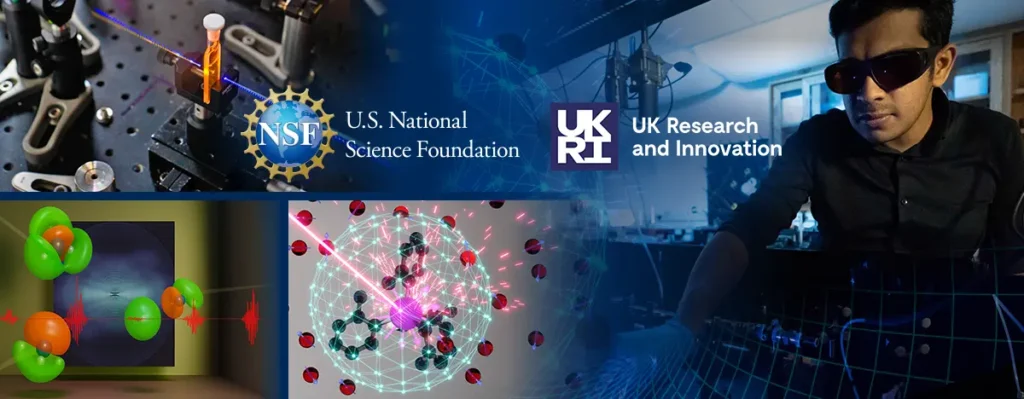
Greg Scholes, the William S. Tod Professor of Chemistry, has been named principal investigator to a new international quantum science grant funded by the U.S. National Science Foundation (NSF) jointly with United Kingdom Research and Innovation (UKRI).
The grant was announced by the NSF this morning. Scholes’ grant is one of eight such awards that together total $10M—$4.7M from the U.S. and £4.2M from the U.K.—in support of collaborative research exploring the role of quantum effects in chemistry.
The grants open a productive new channel for chemists to contribute broadly and substantively to quantum information science (QIS).
By focusing on quantum phenomena in chemistry, the NSF and UKRI are fueling the potential to create new and different types of molecular-based qubits and other fundamental components useful for quantum computing, quantum sensing, and quantum communications … all driven by chemists.
Scholes and his partners at the University of Cambridge and University College London, won the grant for their proposal “Measuring and Understanding Quantum Entanglement in Photochemical Reactions.”

Greg Scholes, the William S. Tod Professor of Chemistry.
While he is eager to get to work on that proposal, the real excitement, Scholes said, is that the grant program marks a turning point for more impactful QIS contributions from the domain of chemistry. Quantum science research that focuses on chemical reactions and molecular platforms, for example, is an untapped area.
“What we’re trying to do is contribute something to this new chapter in the quantum information book,” said Scholes. “The advantage of chemistry is that we can make an extraordinary range of molecules out of atoms, and we need to work out how we can exploit that special ability to gain new insights into quantum science. This is how chemistry will make a big impact on the quantum science field.
“What we need to know is how we can direct some of that to make systems that could demonstrate new quantum phenomena and to solve roadblocks that we have in existing technologies for QIS,” he added. “I’m excited for the collaboration and for the topic in particular. This whole program could produce really important work for chemistry in this field.”
Brian Stone, who is performing the duties of NSF director, said: “By supporting bold, collaborative science, this partnership lays the foundation for advances that can transform everyday life. These projects demonstrate the power of shared investment in tackling real-world challenges, from more powerful computing to next-generation navigation and sensing tools.”
The UKRI’s Jane Nicholson said: “This joint EPSRC-NSF investment in quantum information science in chemistry represents UKRI commitments towards exploring compelling scientific frontiers and working with our international partners. These programs will open new pathways for transformative science and the quantum technologies of the generation yet to come.”
“Through a dynamic partnership, the U.S. National Science Foundation and UKRI are uniting top researchers to unravel the mysteries of quantum in chemical systems,” said White House Office of Science and Technology Policy Director Michael Kratsios.
Workshop generates action
Scholes said the series of bilateral grants stem at least in part from a workshop held a few years ago in Washington, D.C. Scholes spearheaded that workshop with his co-PI on this grant and, later, was a contributing author on a paper summarizing its key points aptly titled, “The Quantum Information Science Challenge,” published in The Journal of Physical Chemistry Letters in January 2025.
That work, Scholes said, put forward eight questions at the intersection of quantum information science and chemistry—“probably impossible to answer completely”—that could be productively investigated by chemists.
Together, the workshop and subsequent paper provide a roadmap for the chemistry discipline to join physicists and engineers who have already carved out impactful avenues of QIS research.
“This workshop was part of the idea to help educate people, get them thinking about what the real questions are and how should we think about them as chemists,” said Scholes. “If chemistry’s going to make an impact on the field, what are we going to do in the next decade or two? What’s the agenda? It gives us a wish list of questions.”
Scholes’ partners in the proposal are Hugo Bronstein, professor of functional materials at Cambridge University; and Alexandra Olaya-Castro of the Department of Physics and Astronomy at University College London.
The grant could also have important implications for the way quantum science is taught in chemistry departments throughout the country, Scholes said.
“This may be a starting point in inspiring education in quantum information science from a chemical standpoint. Everybody’s heard of quantum computing but it’s not relevant to teach that stuff in a chemistry course right now,” he said. “We need more chemistry-centric aspects of quantum science and then we can adjust our curriculum.”
View the full press release from the joint announcement by the NSF-UKRI program.