

Michelle Chang Lab Unveils Powerful New Route to Metalloenzyme Discovery
Massive protein structure prediction databases like AlphaFold, which won the 2024 Nobel Prize in Chemistry, have created a startling index of innovation as scientists come up with new ways to utilize them.
One example is the brace of successes announced last week by the Michelle Chang Lab, including a new metalloenzyme discovery strategy: guided metal-coordination mining. What began as a broad mission to uncover new ways to functionalize C-H bonds using enzymes has resulted in a method that nimbly locates metalloenzymes for powerful new chemistries.
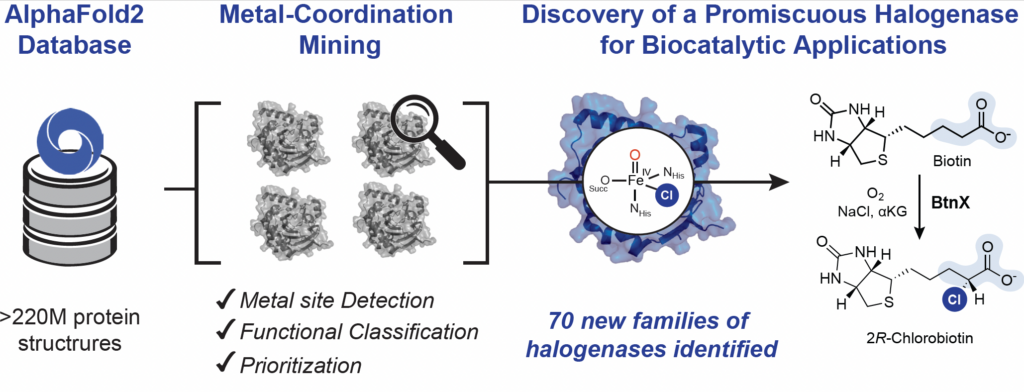
Proving its validity, researchers then used their approach to identify 70 unexplored varieties of the halogenase family – more in the span of one study than have been found in the past 20 years through serendipity alone.
These robust enzymes of the cupin superfamily of proteins are widely dispersed in nature, so finding them with traditional means has been difficult. Among them, biotin halogenase (BtnX), displays substrate promiscuity that is “unprecedented.”
Enzymes are specialized proteins that act as biocatalysts. Researchers seek to map and understand them in order to be able to manipulate their catalytic energy for a range of pharmaceuticals and other applications.
The Chang Lab’s research, Targeted Enzyme Discovery using Metal-Coordination Mining, was published in Nature last week.
“The method is simple to implement yet is very powerful for enzyme discovery,” said Michelle Chang, the A. Barton Hepburn Professor of Chemistry. “It resolves a few longstanding issues for protein discovery: one, how to find rare or new variants in a large and diverse class with high confidence; and two, how to functionally classify proteins that belong to a large and diverse superfamily if they come from different lineages and therefore look very different in sequence space.
“By using 3D space, it makes the search both more precise as well as much faster and easier.”
The Chang Lab is at its core an enzymology lab, but their research is evolving into other subfields. “Now, we have a new interest in merging with the area of biocatalysis. How we can use these enzymes for practical applications in industry, for instance, to make complex molecules for anti-cancer drugs and to carry out the most challenging chemistry?” said Ioannis “Yanni” Kipouros, a postdoc in the lab and first author on the paper.
“We wanted to have a general method to find metalloenzymes within large databases, but also to have a specific application. We’re showing a new implementation or new use of AlphaFold and how this wealth of information can be used to identify in a very targeted way metalloenzymes of interest.”
Mining Large Databases for novel enzymes
The lab used the AlphaFold Protein Structure Database as the basis of their research. Armed with mechanistic insights into the role of enzymes and metal-protein interactions, researchers combed the databases looking for specific metal-binding sites of interest, and then identified in that group the diversity they care about.
It is estimated that up to 50% of proteins require a metal ion to function. This is the molecular distinction that researchers exploited to develop metal-coordination mining, targeting “islands” of enzymes as they explored the massive data space.
“Enzymes that catalyze some of the most challenging and interesting chemistry tend to employ metals as cofactors in their active sites. Proteins fold into a complex 3D structures and that’s where metal-binding properties can emerge,” said Kipouros.
“We hypothesized that we could leverage our fundamental understanding of metal coordination chemistry to first identify where metals can bind within a protein structure and then use the metal coordination environment to predict their function. Can we develop computational methods to implement this idea and mine the new massive databases at scale to find rare metalloenzymes of interest?”
This is metal-coordination mining in action: generalizale, scalable, and ideal for managing the bounty of structure prediction afforded by these databases.
Chang lauded the ability for the implementation of new search methods with these databases that are generalizable. “We don’t use any sophisticated methods such as molecular docking or computation so we think that many labs can easily use this approach for many different purposes,” she said.
Kipouros added: “Our metal-coordination mining approach demonstrates a new way to harness the power of the AlphaFold Protein Structure Database” he said. “At the same time, our approach extends beyond halogenases, and in fact, provides a very generalizable framework that can accelerate discovery of a wide range of new metallonenzymes.”
This research is supported by funding from the National Institutes of Health (R35 GM161243 and R01 GM13427).