

Princeton Chemistry’s Postdocs: Jeremy Owen at the threshold of theory and experiment
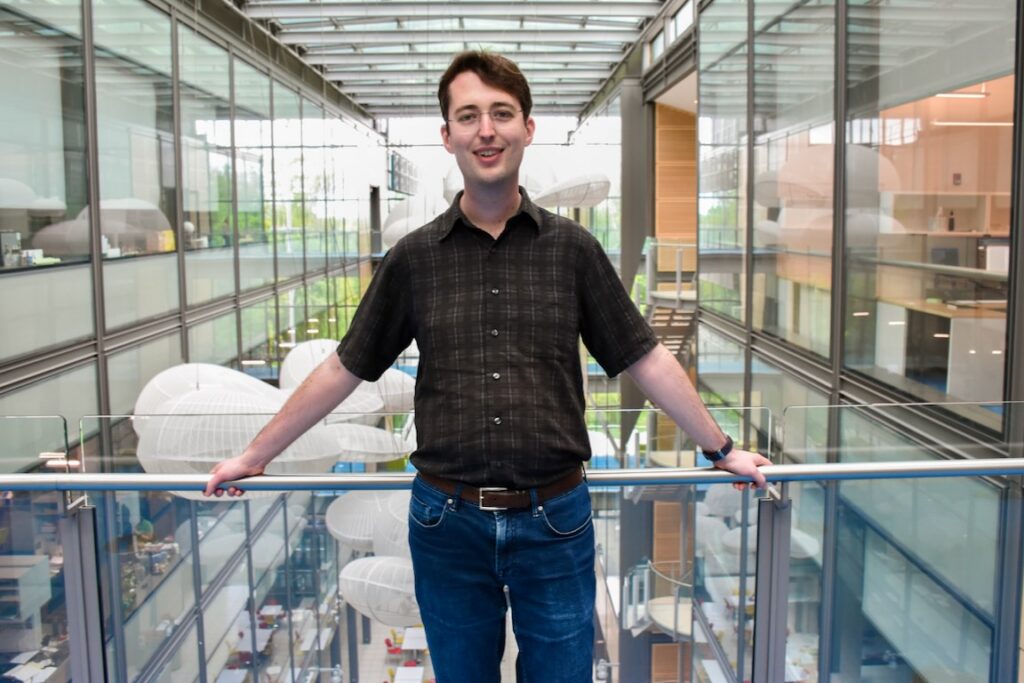
Postdoctoral Fellow Jeremy Owen brings an unusual academic pedigree to Princeton Chemistry. With an undergraduate degree in math and a doctorate in physics, he arrived three years ago in the Muir Lab as its first-ever computational theorist. To do research in biochemistry. Which he had to learn from the ground up.
It’s the kind of unconventional partnership that could yield startling results for the lab’s research on chromatin biology. Or, as Owen calls it, “the dizzying and beautiful complexity of chromatin.” Nobody is looking forward to the possibilities more than his adviser Tom Muir.
“I couldn’t believe my luck that someone with Jeremy’s background would be interested in a biochemistry lab,” said Muir, the Van Zandt Williams Jr. Class of 1965 Professor of Chemistry. “He made a compelling case for why his physics and theory background would complement our experimental work. We were both of the view that the epigenetics field was at a point where this axis was likely to be a productive line of enquiry.
“What is really unique and impressive about Jeremy is that he actually wanted to generate his own data to model. This meant learning experimental chemical biology and biochemistry. He is now doing exactly that at a high level. I could not be more excited to see what comes out of all this.”
Owen was born in London. He got his undergraduate degree at Cambridge University and then went to Boston for his doctorate from MIT. The family moved around a lot. So it’s not surprising that he has a cosmopolitan bearing that seems more appropriate to a philosophy class than a chemistry lab.
Owen himself likes these dichotomies. It’s one of the strengths he uses to make headway in the thicket-y world of chromatin research, a research pillar of the Muir Lab.
“As a biophysicist or a quantitative biologist – I don’t know what you want to call me – I’m interested in simple, physically inspired or mechanistic models of small data measured carefully,” said Owen, who is co-mentored by Ned Wingreen in the Department of Molecular Biology. “You can either do big data, or you can just make one measurement really, really carefully. It’s amazing how even at that level there’s a lot of work that needs to be done and a lot that you can learn.
“From a scientific perspective, what appealed to me in the Muir Lab is that when anyone builds a model, you can’t put everything into it. You just have a few elements and your question is, could these elements explain some biological observation? In Tom’s experiments, he is able to do this because he has such conceptual clarity. He just takes one or a few elements. I like that approach, and it certainly feeds well into building a model.”
Focusing on remodelers
In 2024, Owen was named a Damon Runyon Cancer Research Foundation Quantitative Biology Fellow for his project, The biophysics of substrate recognition in chromatin remodeling. He aims to understand how chromatin remodelers recognize their target sites so that they can cue modifications.
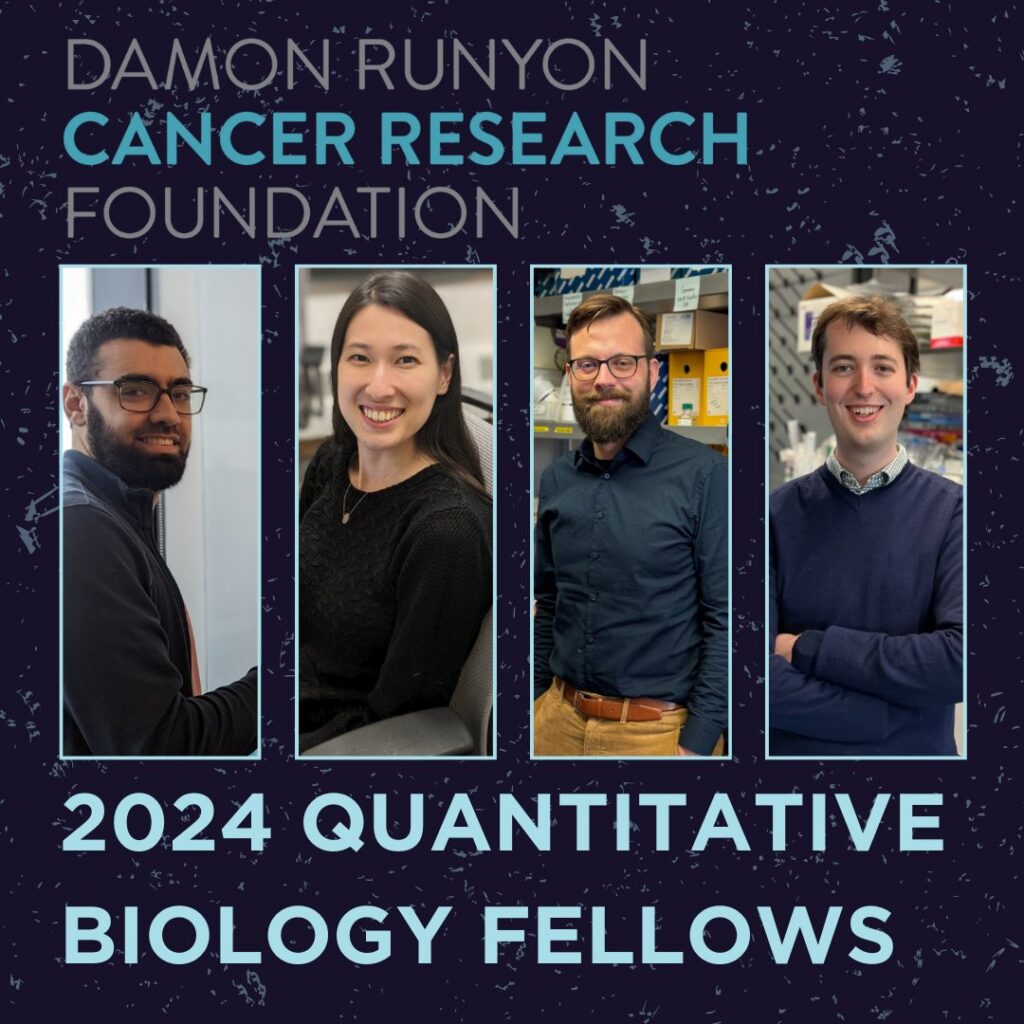
Owen was among four postdocs selected for a special 2024 grant from the Damon Runyon Cancer Research Foundation. His grant runs through 2027.
Chromatin is a DNA-protein complex within human cells. Its architecture enables a tidy compaction of DNA in the confined space of the nucleus. Layered within that complex are “these amazing molecular motors” called remodelers. They shift structural components around within the chromatin like they’re moving furniture – ejecting some components, reordering others, and ignoring still others.
Owen is specifically interested in what directs these regulators to specific sites within the cell. This is biological material serving a biological purpose: how does it know where to go?
Understanding that—and one day possibly being able to manipulate the process for treatment—could have immense implications for human disease because dysfunction in this mechanism is strongly implicated in cancer.
So Owen is developing his models to decipher the behavior of remodelers. He meticulously measures and iterates their ability to target a particular space within the cell again and again and again, and what signposts are directing this homing behavior.
“This is where the computational modeling can come in,” said Owen. “Because by observing the activity of these remodelers when a signpost is present versus when it’s absent, with an intermediating model, we can try to figure out how the remodelers are reading these signposts. And I’m interested in whether remodelers kind of pause when they’re reading these signposts, basically to make a better or more precise decision.
“That’s called kinetic proofreading, and it was first proposed here at Princeton in the 1970s by John Hopfield,” he said of the Nobel Prize-winning physicist, now an emeritus professor in Molecular Biology. “So basically, I’m going to make some observations of these remodelers acting in vitro, and look for a signature of this kinetic proofreading mechanism.”
High risk, high reward
The Damon Runyon Fellowship challenges young scientists to break ground through “high-risk, high-rewards projects” in cancer research.
Owen honors that mission by investigating DNA sequences within chromatin and the transcription factors that guide remodelers, focusing on one in particular: the BAF complex. This huge protein complex is crucial for the regulation of gene expression. It’s often mutated in certain kinds of cancers, so it clearly has a role in disease states.
Owen’s work to date suggests that transcription factors can augment remodeling activities in ways that have implications for the regulation of genome architecture. Going forward, this could become an important piece of the biological puzzle that is chromatin.
It’s one of the many factors in this field that continue to inspire Owen’s postdoctoral work.
“Chromatin is subject to these chemical modifications at many sites sort of simultaneously, so you can have many different sites that can be modified in different ways, and you get all the different combinations of these modifications in principle,” said Owen. “That is what’s dizzying about it. It’s like looking down a cliff.
“But then, at the end you remember that this whole thing works biologically to do something,” added Owen. “Nature pulls it off.”