

Summer Series: Papers We Love with Tom Muir
The Princeton Department of Chemistry publishes nearly 300 journal papers each year. Some of them make quite a stir. Others glide along under the radar with citations that ebb and flow based on whether a particular field is in play. Still others lodge themselves in their authors’ minds as representative of a lab’s greater mission.
This summer, we’re highlighting papers in this third group; the ones that were “magical,” even formative in a faculty member’s development. Like this one from Tom Muir, the Van Zandt Williams Jr. Class of 1966 Professor of Chemistry: “Ion Selectivity in a Semisynthetic K+ Channel Locked in the Conductive Conformation.” It appeared in the journal Science in November 2006 under authors Francis Valiyaveetil, Manuel Leonetti, Muir, and 2003 Nobel laureate Roderick MacKinnon.
Enjoy our brief Q&A, below.
Why is this paper important to you?
This one is a bit of a deep cut—an oldie but goldie—and it has been on my mind recently for various reasons. It is my favorite of a series of papers we published with Nobel laureate Rod MacKinnon, work that was conducted while I was still on the faculty at The Rockefeller University in NYC. I like it because it uses stereochemical principles to address a fundamental question in molecular electrophysiology; namely, what is the structural basis of ion selectivity in a potassium ion channel?
The work was the culmination of several years of really painstaking work in which we established chemical methods to synthesize fully active potassium channels – pore-forming membrane proteins that conduct K+ (but critically not Na+) down their electrochemical gradient and that play essential roles in physiology by setting the resting potential of cells. i.e. they are pretty important!
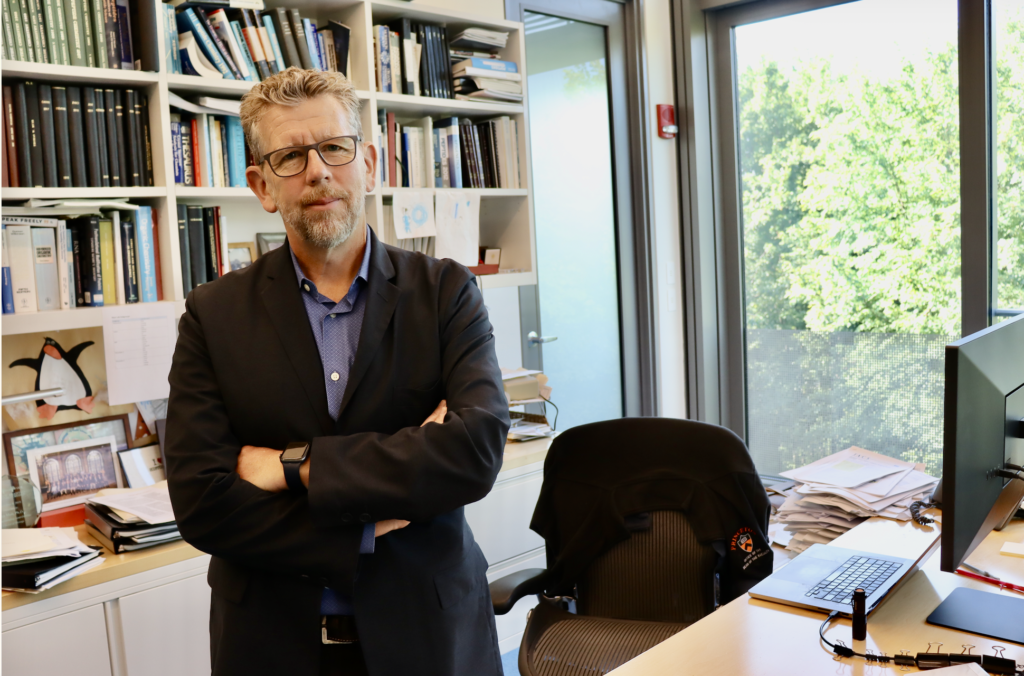
Tom Muir, the Van Zandt Williams Jr. Class of 1966 Professor of Chemistry.
What was the takeaway message?
Rod’s lab had famously solved the crystal structure of a bacterial K+ channel, seminal work that revealed the overall architecture of the tetrameric protein and beautifully illuminated the path that K+ ions use to move through the membrane embedded protein. Our paper was designed to explore the contribution of conformational flexibility in the ‘nerve center’ of the protein (the so-called selectivity filter) in allowing the conduction of K+ over Na+.
This flexibility hinges on the unique conformational properties of a conserved glycine residue in the filter – glycine is the only proteinogenic amino acid that can access D- and L-dihedral space in the protein backbone. Using chemistry, we replaced this glycine with a D-alanine residue (i.e. stereochemical protein engineering) and showed by X-ray crystallography that the resulting diastereomeric protein was locked in the conductive conformation, something that we had predicted. Remarkably, the D-alanine channel was now able to conduct Na+ in the absence of K+. This demonstrated that the ability of the channel to adapt its structure depending on which ion was present in the filter is an important component of selectivity.
How did this paper contribute to the broader field?
Beyond shedding some light on potassium channel function, I think this paper was a milestone in the protein synthesis area by showing that complicated membrane proteins of this type could be manufactured in high purity and in amounts needed for detailed structural and functional studies. I think it also illustrated the power of chemistry for studying protein function, since this experiment could not have been achieved in any other way (at least not on this planet).
Also, seeing a single copy of a protein that you built using chemistry conduct ions (channel electrophysiology is the prototypical single molecule technique) was, for me, a truly magical experience.