

Quantum biology is a thing, so how do we advance it experimentally?
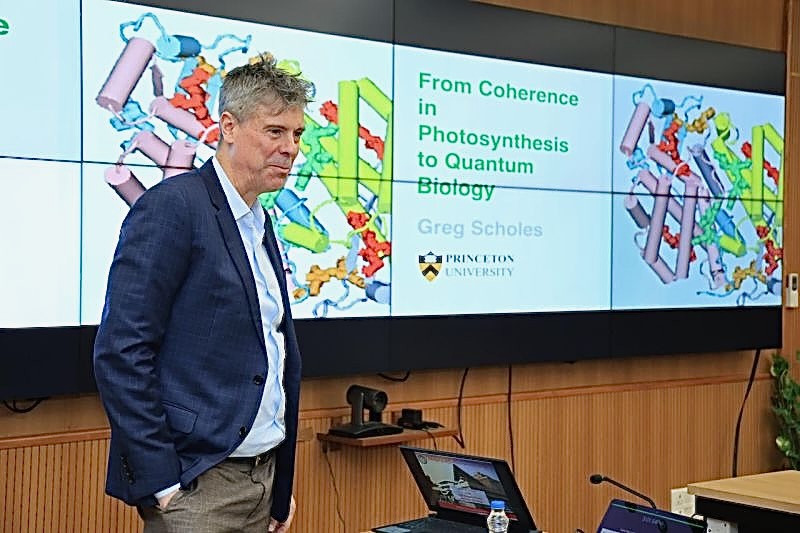
Greg Scholes offers a perspective on the incipient field of Quantum Biology in the Proceedings of the National Academy of Sciences (PNAS). The field seeks to answer broad questions about the role of quantum mechanics in biological systems. It is emergent because, for at least the last century, biology was thought to play out only in the warm, wet environments of the classical scale. Scientists believed there was too much noise inherent in those systems for the delicate workings of quantum mechanics.
Lately, this conclusion has come under scrutiny.
Scholes, the William S. Todd Professor of Chemistry, has long been interested in that branch of inquiry at the intersection of the classical and the quantum worlds. With this new perspective, he and co-author Graham Fleming propose an “agenda of experiments” that could begin to address the larger scientific and philosophical questions around quantum biology, thus defining its scope and providing a path forward.
PAPER: “What is Quantum Biology?”
JOURNAL: Proceedings of the National Academy of Sciences (PNAS).
AUTHORS: Gregory Scholes, the William S. Tod Professor of Chemistry; and Graham Fleming, University of California, Berkeley.
WHAT IT IS: Over the past few decades, researchers have sought a compelling example of a macroscale function so strikingly different from what could be achieved with a classical function that quantum mechanics provide the only explanation.
Scholes and Fleming address this goal by exploring how quantum effects—entanglement, tunneling, superposition—can be embedded deep within a complex biological system so they are basically hidden from view.
They provide a framework of questions for experimental work that might begin to address this hypothesis. Two examples, photosynthesis and migratory bird navigation, lie at the heart of their discussion.
FOCUSING ON A FEW CRUCIAL AREAS: The perspective focuses on several rich areas for exploration, including electromagnetic fields in biology and how these systems interact with light; coherence, synchronization, and resonance, and whether light harvesting is efficient because coherence is modifying the process on an ultrafast timescale; and macroscopic timescales and whether relevant quantum phenomena exist with large length scales.
QUESTIONS FOR CONSIDERATION: Scholes and Fleming provide three underlying questions. These are clear targets for discovery. Among them:
o What measurements can reveal incisive evidence for quantum function?
o Do complex classical systems possessing states that convincingly mimic useful properties of quantum states exist?
o How are the microscale mechanisms that engage quantum-mechanical or
quantum-like phenomena amplified to the biological scale so as to provide a functional basis for new classical functions?
COMMENT FROM P.I. GREG SCHOLES: “There are so many people interested in quantum biology, but the field doesn’t seem to go anywhere. We wanted to propose a kind of agenda of experiments that will potentially reveal whether there are interesting quantum mechanisms underlying biological functions. But how do you look for them? How do you prove the mechanism is quantum?
“We do not know if nature uses quantum phenomena for function (in a non-obvious way). If someone could do an experiment that shows a ‘big,’ compelling example, that would make the field. So far, it remains only a tantalizing idea. We are trying to provide a lens to focus efforts in the field.”
NEXT STEPS: Scholes and Fleming conclude that there is good reason to believe that advances in experimental strategies—informed by considering how quantum or quantum-like phenomena might hide in biological systems—will soon discover clear examples of how biology can engage the quantum world.