

Subotnik Group’s Zain Zaidi Named a Hertz Fellow
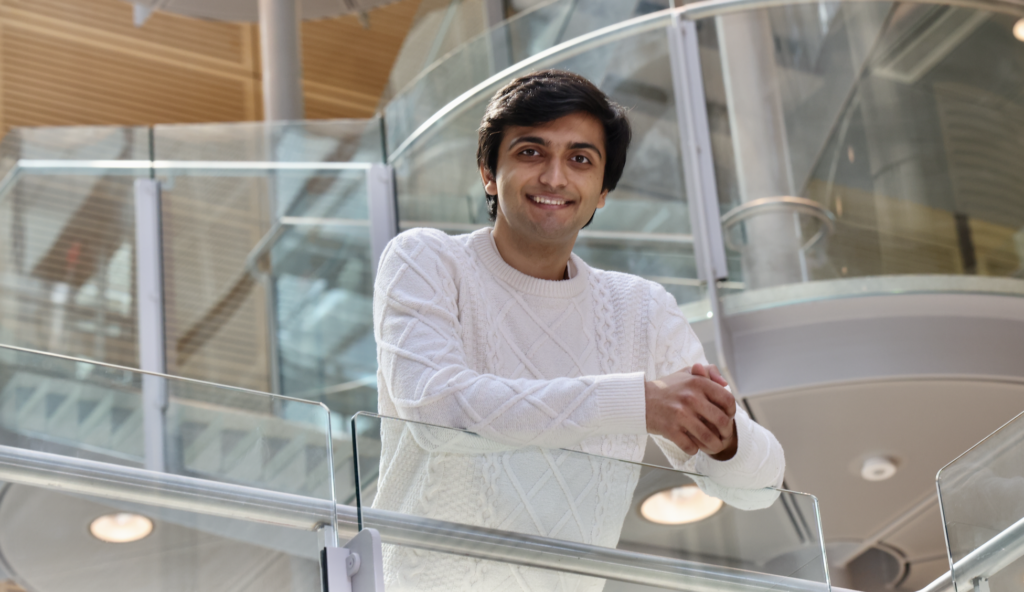
Zain Zaidi, a first-year graduate student with the Joseph Subotnik Group, has been named a 2026 Hertz Fellow in the applied sciences, mathematics, and engineering, one of just 19 individuals selected nationwide.
The Hertz Fellowship is one of the nation’s most competitive doctoral fellowships in the applied sciences, providing up to five years of financial support — a stipend and full tuition equivalent — along with membership in a lifelong community of scientists and engineers working across disciplines. The announcement was made this week by the Hertz Foundation, a public charity marking its 63rd year of awards committed to advancing American scientific and technological leadership.
Zaidi’s research in theoretical and computational chemistry seeks to enable next-generation materials and technologies for sustainable energy applications.
“I was in my office downstairs and I had just come up in the elevator, lunch finished, and I got an email that said there’s a notification on my portal. I couldn’t even read the text because I was so nervous. I just saw ribbons going down and thought, omg, I’ve won,” said Zaidi. “I sprinted out of my room with my laptop to tell our group. I called my mom like an hour later.
“I think the most beneficial part about the Hertz Fellowship is the intellectual freedom you are given. Hertz is really funding the scientist and allowing you to go beyond what might traditionally be allowed through federal grants or what your P.I. could fund. So it allows me to take the research that I’m doing with Joe and really push it in unprecedented directions.
“The scientific method allows us to iteratively solve the unknowns. As graduate students, we’re learning how to do that discretization process – how do you split up the massive complexity of the natural world and make it into some bite-sized piece that you can tackle at a very deep level? For me, that really ties into intellectual freedom. You can do what you’re told. Anyone can do what they’re told, to a degree. The real power is how your curiosity guides you in solving the big, open questions.”
Zaidi was also awarded a 2026 Paul & Daisy Soros Fellowship for New Americans last month.
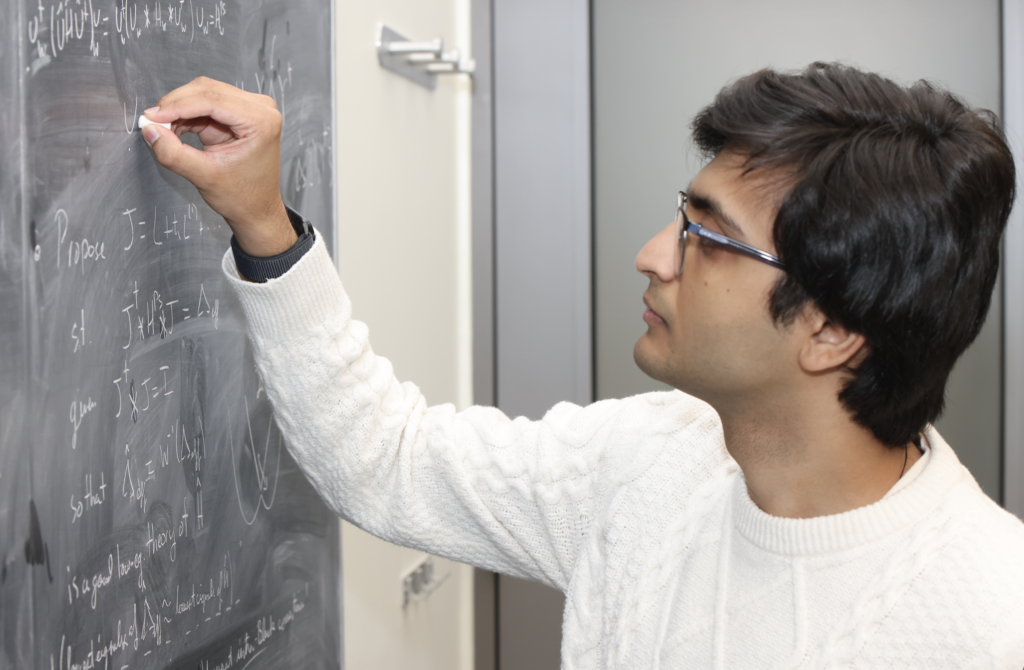
Zaidi working on a project in Princeton Chemistry's Frick Lab.
Three other Princeton researchers have also been named Hertz Fellows this year, including incoming graduate student Tyler Hou, graduate student Elizabeth Kozlov, and undergraduate alumnus Zachary Siegel.
Joseph Subotnik, David B. Jones Professor of Chemistry (and a 2001 Hertz Fellow), has been Zaidi’s mentor for just a half-year now. “Working with Zain is a joy,” he said. “Zain has many ideas of his own and he’s always looking to connect different ideas from different disciplines together. He also tests new ideas very quickly, so progress comes quickly.
“He came to Princeton already knowing about nonadiabatic dynamics, so he was able to jump right in and get started.”
Research Broad and Wide
Zaidi’s current project at Princeton Chemistry advances an investigation begun by former Subotnik Group postdoc Xuezhi Bian on Born-Oppenheimer Theory. While the theory has been used for nearly 100 years to calculate the dynamics of molecules, some scientists are revisiting its generalized approach, including the Subotnik Group.
Zaidi holds up a plastic bottle filled with water to broadly illustrate how Born-Oppenheimer comes up short on molecular movement. Analogously, he calls the bottle itself the nucleus and the water inside it the electrons. Born-Oppenheimer’s approximations can be likened, Zaidi said, to taking into account only the position of the bottle without reference to the motion of the liquid it contains.
“Under Born-Oppenheimer, for example, all that matters is how the plastic bottle is oriented, not how fast it’s moving; the liquid, in this theory, would always be perfectly stationary, which doesn’t make any sense at all,” said Zaidi, tipping the plastic bottle back and forth. “We’re developing a theory that you can actually conserve momentum so that you can get this ‘liquid’ problem right; the notion of momentum conservation.”
This problem ties to a broader project regarding chiral-induced spin selectivity, which can contribute down the line to new efficiencies for solar cell devices, new ways of doing electrocatalysis, photocatalysis, and aid in the development of new drugs.
“These questions about spin-dependent electron transfer and homochirality come down to, how does electronic spin, electronic momentum, and nuclear motion control the transfer of electrons,” said Zaidi. “Electron transfer is super important in biology. This is how cells respire, through the electron transport chain. This is how plants photosynthesize, through similar electron transfer events.
“It’s the central question of my Ph.D. – how does nuclear momentum, electronic momentum, and electronic spin couple together in electron transfer?”
Born in Saudi Arabia, Moved to Texas
Zaidi was born in Alkhobar, Saudi Arabia to Pakistani parents, but has few memories from that time. One of his earliest memories, after the family moved to Coppell, Texas, was watching his older brother inspecting a circuit board.
Because his parents put a password lock on the family computer, Zaidi was unable to access it alone when he was young. Instead, he would pull books off the family’s bookshelves and read in the early morning. One of his favorites was The New Book of Knowledge, in which he first saw an intriguing entry on chemistry.
“There were all these things about turning lead into gold and all these magical things,” said Zaidi. “As a kid, and even today, I loved magic and thought chemistry was as close as I could get in real life to a magical system.”
Zaidi received his undergraduate degree in chemistry from Stony Brook University (in three years) under the mentorship of Benjamin Levine and Arshad Mehmood.
Today, one of the things Zaidi wants most from his doctoral pursuit is to answer big questions, riffing off the well-known exuberance of Subotnik to pursue new directions.
“I really want to work on some of the fundamental questions with Joe,” said Zaidi. “There are so many open questions, and they can all influence the solving of real-world problems. Because even though it’s theoretical and computational, I really do want my work to resolve problems in society, whether it be in renewable energy or energy security or drug synthesis. I am really looking forward to that.”
The full Hertz Foundation press release is available here.