

Chemistry Summer Series: Papers We Love … with Martin Semmelhack

The Princeton Department of Chemistry publishes nearly 300 journal papers each year. Some of them make quite a stir. Others glide along under the radar with citations that ebb and flow based on whether a particular field is in play. Still others lodge themselves in their authors’ minds as representative of a lab’s greater mission.
This summer, we’re going to highlight papers in this third group; the ones that were magical, even formative in a faculty member’s research program.
Like this one from Professor of Chemistry Martin Semmelhack: Total Synthesis of the Cephalotaxus Alkaloids. A Problem in Nucleophilic Aromatic Substitution, which ran in the Journal of the American Chemical Society (JACS) in April of 1975, with Semmelhack writing as an assistant professor at Cornell University.
Enjoy Marty’s Q&A below.
Why is this paper important to you?
I take that question to be quite personal and will outline an early project that was significant to me. The year was 1972. For an assistant professor in his third year, this project had enormous significance: it defined our approach to organic chemistry research, reassured us that disappointing results could be overcome with new ideas, stimulated a focus on the new area of organo-transition metal chemistry, and, not least, delivered a positive influence on a tenure decision!
How was the problem identified?
Organic synthesis research can be driven by the discovery of new structures from nature, especially if there is a suggestion of important biological activity and limited availability from the biological sources. Perhaps equally important is that new structures can stimulate the discovery of new synthesis methods.
As my research group began to establish itself, we looked to fairly simple new natural products for inspiration, but we were also thinking about how transition metals could promote new reactivity of organic molecules that would lead to new general methods. This overlap of inorganic and organic chemistry was just beginning to emerge: the journal Organometallics did not exist (nor did its current editor, Paul Chirik, yet exist!)
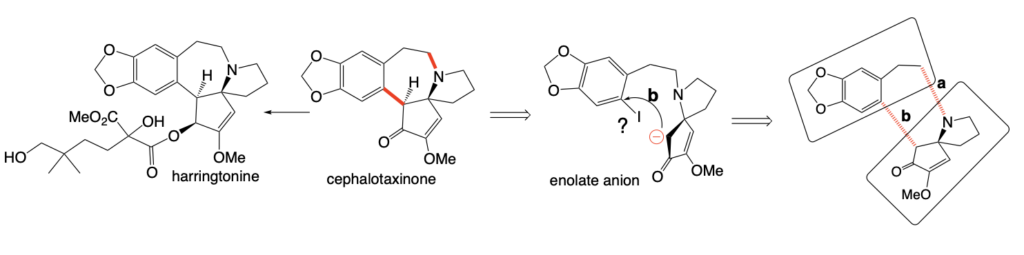
It was reported that harringtonine, a minor product in certain Yew trees, and ester analogs had varying degrees of anti-cancer activity. The precursor was also a natural product, cephalotaxinone. A direct convergent synthesis strategy might involve formation of the seven-membered ring from two fragments: bond a would arise by a simple substitution reaction, but bond b looked more challenging. An enolate anion could be generated, but how to activate the electron-rich arene ring to undergo substitution?
There were some suggestions in the literature that could be tested and, in parallel work, we had discovered the facile activation of aryl halides with Ni(0) and wondered if that could be applied.
What was the takeaway message?
The overall message comes from a series of tests of relatively undeveloped suggestions from the literature, along with some new ideas.
The first was a test of the “benzyne” process for aromatic substitution. This was successful, giving us the first synthesis of cephalotaxinone, albeit in only 15% yield for the last step. It enabled publication of a preliminary communication in JACS. It also provoked a letter from the organic chemistry giant Albert Eschenmoser, whom I had never met. He reminded me of a paper I failed to cite but then complimented me (sort of): “Anyone who reports a 15% yield has got to be an honest man.”
We next formulated a mechanism for the ring closure involving Ni(0) activation of the aryl iodide, ligand exchange with the enolate anion, and reductive elimination of cephalotaxinone, suggesting a process catalytic in Ni(0), overall. After many experiments, the best yield was only 30%. That it would work at all in this fairly complex system was unprecedented and intriguing.
An interesting series of papers suggested that haloarenes could be converted to phenyl radicals and trapped with simple nucleophiles; none were in moderately complex substrates.
There were two tactics described in the original work to generate the radical: reduction with alkali metals or UV photolysis. The alkali metal recipe seemed brutal, but it worked: about 65% conversion and 50% yield. Even better, when the reaction mixture (dissolved in liquid ammonia) was irradiated for an hour, the graduate student’s eyes nearly popped out: evaporation of the ammonia and simple chromatography gave cephalotaxinone a 94% yield, with no byproducts. The problem was solved: 10% overall yield over eight steps.

Professor of Chemistry Martin Semmelhack, today.
What did this paper contribute to the broader field?
While the paper and two preliminary communications have seen 450 citations, I chose it because of the impact it had on my own research. In retrospect, however, several of the ideas explored in the paper assumed much greater significance as they were developed by others.
The nickel-catalyzed process is based on a mechanism that had been discussed in simple cases but not been developed into general methodology. Unknown to us, Kumada had, in 1972, opened the floodgates to develop this mechanism using Pd(0), and it became one of the most transformative advances in organic synthesis in the decades to come: palladium-catalyzed cross-coupling.
The photo-initiated radical chain coupling has some of the ingredients of photo-redox catalysis (controlled radical reaction, without the catalyst), which has come into its own as an astonishingly general methodology in the last decade or so. Looking back, one can see how straight-forward it would be to use either of these general methods for the final step in the cephalotaxinone synthesis.
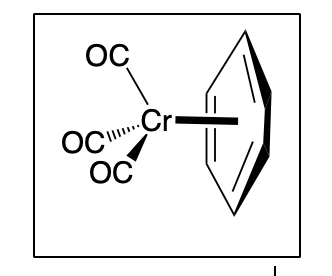
For my research group, however, the project’s greatest significance lay elsewhere. It exposed just how limited the available methods for arene substitution really were. Once the cephalotaxinone problem had been solved, we turned our attention to the broader challenge of arene activation and launched a research program exploring new reactivity based on π-complexation with transition metals, exemplified by chromium arene complexes. The result was a decades-long project, resulting in 35 or so papers, the synthesis of several natural products, and demonstration of new reactivity based on metal activation.