

Summer Series: Papers We Love with Paul Chirik
The Princeton Department of Chemistry publishes nearly 300 journal papers each year. Some of them make quite a stir. Others glide along under the radar with citations that ebb and flow based on whether a particular field is in play. Still others lodge themselves in their authors’ minds as representative of a lab’s greater mission.
This summer, we’re highlighting papers in this third group; the ones that were magical, even formative in a faculty member’s research program.
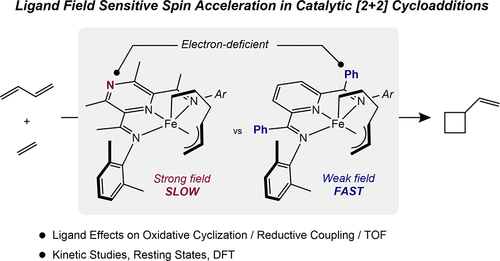
Like this one from Edwards S. Sanford Professor of Chemistry and Department Chair Paul Chirik: Ligand Field Sensitive Spin Acceleration in the Iron-Catalyzed [2+2] Cycloaddition of Unactivated Alkenes and Dienes, which appeared in the Journal of the American Chemical Society (JACS) in March 2024 under authors Hanna Cramer, Coralie Duchemin, Carli Kovel, Junho Kim, Matthew Pecoraro, and Paul Chirik.
Enjoy our brief Q&A below.
Why is this paper important to you?
This paper revealed why the iron catalysts we have studied for nearly 20 years are so special. One reaction they promote is the 2+2 cycloaddition of alkenes with alkenes or alkenes with dienes to form cyclobutanes (’squares’). These reactions are forbidden under thermal conditions, and we had shown some time ago that iron catalysts with redox-active pyridine(diimine) ligands on them were unique in promoting cyclobutane formation. These reactions are important because they are a straightforward route to unique fuels and chemically recyclable plastics that can’t be made any other way. This is even more remarkable when you think about the petrochemical industry and scores of academic labs that had been studying the reactions of alkenes and dienes with metal catalysts for decades!
In this paper, my postdoc at the time, Hanna Cramer, made several variants of the iron catalyst to see how changes to the structure made cyclobutane formation go faster or slower. By doing this along with isotopic labeling experiments and DFT calculations, she figured out why the iron catalysts are special.
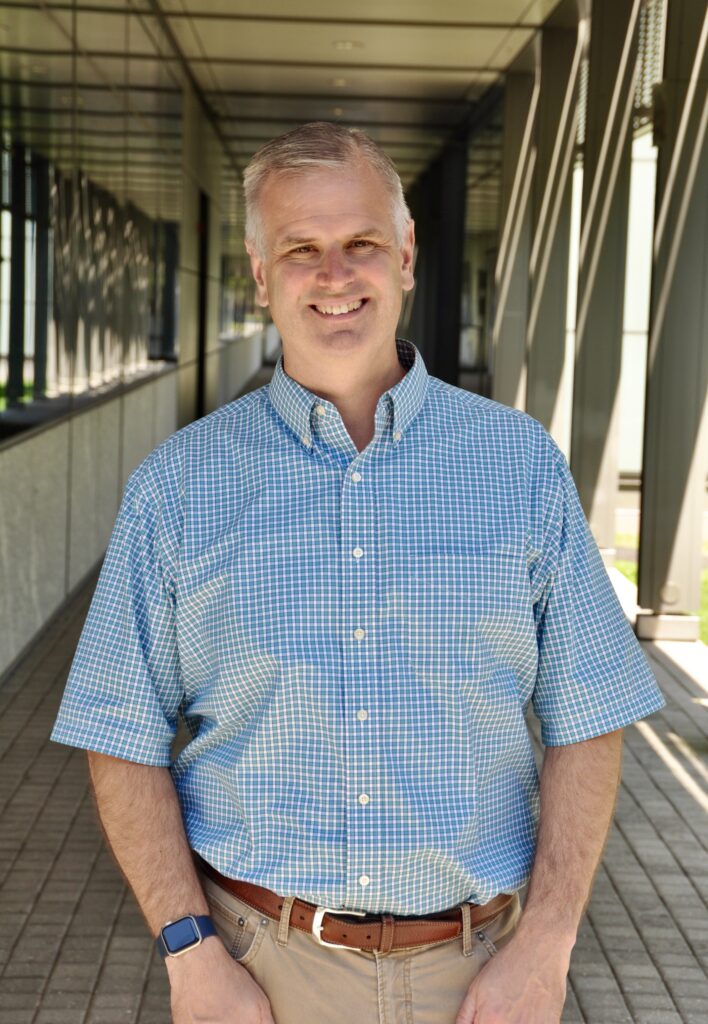
Edwards S. Sanford Professor of Chemistry and Department Chair Paul Chirik outside Frick Lab.
What was the takeaway message?
The takeaway message is that the iron catalysts are special because of the ‘redox-active’ ligand. Typically metals in catalytic reactions undergo electron transfer at the metal; in these complexes, the supporting ligand also gets involved. What Hanna showed is that the ability of the ligand to be ‘redox-active’ accelerated formation of carbon-carbon bonds en route to the cyclobutane ligand. She did this by cleverly keeping everything about the catalyst the same except the ‘redox-active’ ability of the ligand. Hanna found that accessing a one-electron redox change at the ligand and a high-spin state at the iron are key for forming the square. This was a really exciting discovery for us as it showed definitively that redox-active ligands turn on chemistry that hasn’t been done without them. This was the cherry on top of the sundae that was about 20 years in the making!
What question did your lab want to answer with this research?
The paper came about because we were trying to make faster catalysts. The iron compounds take commodity alkenes and dienes and make products that are potentially really valuable – as improved fuels, more durable or recyclable plastics. The cost of these materials is related to how fast the catalyst operates. If it goes faster, the less catalyst that is used and, in the end, the cheaper the final product. Hannah, with a small assist from graduate student Carli Kovel, discovered catalysts that do indeed go faster. More importantly, they were able to correlate the structure of the catalyst with its function and ultimately solve the mystery of the redox active ligand.
How does this paper contribute to the broader field?
For us, this paper has been game changing. Its findings have pushed our research in new directions focused on ‘open shell organometallic chemistry.’ For 50 years, organometallic catalysis has focused on metal complexes where all of the electrons are paired. This gives rise to predictable and game-changing catalysis for organic chemistry. This paper showed us that metal complexes that have unpaired electrons—once thought to be deleterious for catalysis—actually offers new chemistry that no one has seen before. We are now exploring this concept broadly in our program.
This 2024 work was supported by the U.S. Department of Energy, Office of Science, Office of Basic Energy Sciences, under Award DE-SC0022303, and by the Gordon and Betty Moore Foundation.