

Torquato collab opens door to design of disordered materials for delocalization of waves
Longtime collaborators Salvatore Torquato (Department of Chemistry) and Paul Steinhardt (Department of Physics) investigate a phenomenon called Anderson localization as it relates to stealthy disordered solids, a special type of exotic matter for which localization exhibits a dramatically different behavior.
The general “lore” of the field says any kind of disorder in a one-dimensional system disrupts the ability of electrons to move freely through it. When electrons cannot move freely, they are localized, concentrated. But researchers found that stealthy hyperuniform disorder can modify a 1D system and delocalize it so that electrons can indeed propagate through. They are calling this capacity “effective delocalization.”
Their report, published earlier this month in Physical Review Letters, adds an interesting perspective to the Anderson localization model by underscoring new regimes in which any finite-sized system, for all practical purposes, can be delocalized.
PAPER: Effective Delocalization in the One-Dimensional Anderson Model with Stealthy Disorder
JOURNAL: Physical Review Letters, April 14, 2026.
AUTHORS: Carlo Vanoni, Jonas Karcher, Mikael Rechtsman, Boris Altshuler, Paul Steinhardt, and Salvatore Torquato.
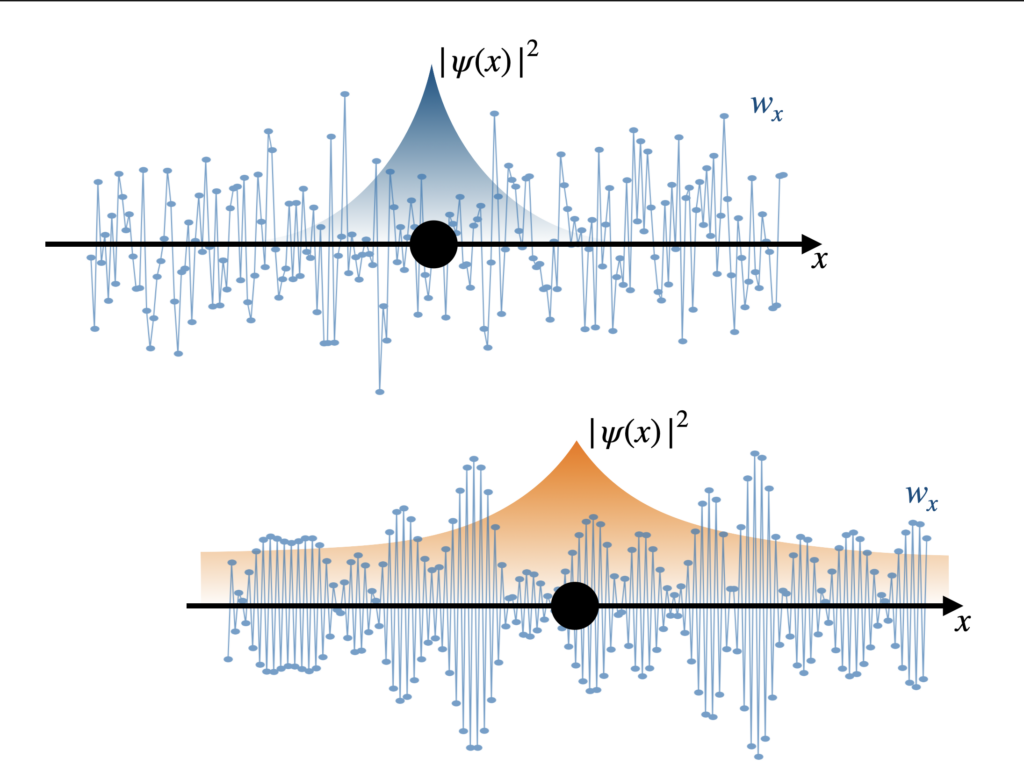
Two different 1D Anderson models: wave localization with typical disorder (top) and wave delocalization with stealthy disorder (bottom).
WHAT IT IS: Novel kinds of order can “hide” inside matter, impacting the behavior and properties of materials. Torquato has been exploring this phenomenon since he and Frank Stillinger first introduced the idea of hyperuniformity, or hidden order, back in 2003.
In this latest study, Torquato, Steinhardt, and Vanoni take as their springboard work by the late theoretical Princeton physicist Philip Anderson, whose model on the electronic structure of magnetic and disordered systems was introduced in 1950. Anderson theorized that electrons will not propagate through any 1D materials that exhibit disorder. Instead, they would be stopped, or trapped. Known as Anderson Localization, the idea won him a Nobel Prize back in 1977.
With their latest in Physical Review Letters, researchers highlight the intriguing exception that for certain disordered systems, transport can be recovered in large samples.
A CRUCIAL POINT: While Anderson localization remains intact, stealthy hyperuniform materials can extend the localization length and enable transport through arbitrarily large finite samples. (The localization length is the size of the region of space over which a quantum particle gets trapped due to the presence of disorder.)
Scientists can therefore engineer this exotic form of disorder so the resulting localization length is very large and can exceed the finite size of the system, enabling delocalization; that is, the free transmission of waves.
COMMENT FROM PI SALVATORE TORQUATO, LEWIS BERNARD PROFESSOR OF NATURAL SCIENCES, PROFESSOR OF CHEMISTRY: “The idea in the past was that if you introduced any level of disorder into a one-dimensional ordered lattice, waves could no longer propagate or transport through the material. We have shown in this paper that if you have this special type of disorder, stealthy disorder, you can get what we call ‘effective delocalization’ for very large samples of the material. Waves propagate in the presence of this disorder, even for large samples. That’s the beauty of it. Our work challenges our previous knowledge of Anderson localization and our notion of the nature of disorder.
“An important takeaway from this letter is that this really strange, exotic form of disordered matter—that is between a crystal and a liquid—ends up having extremely surprising and desirable physical properties.”
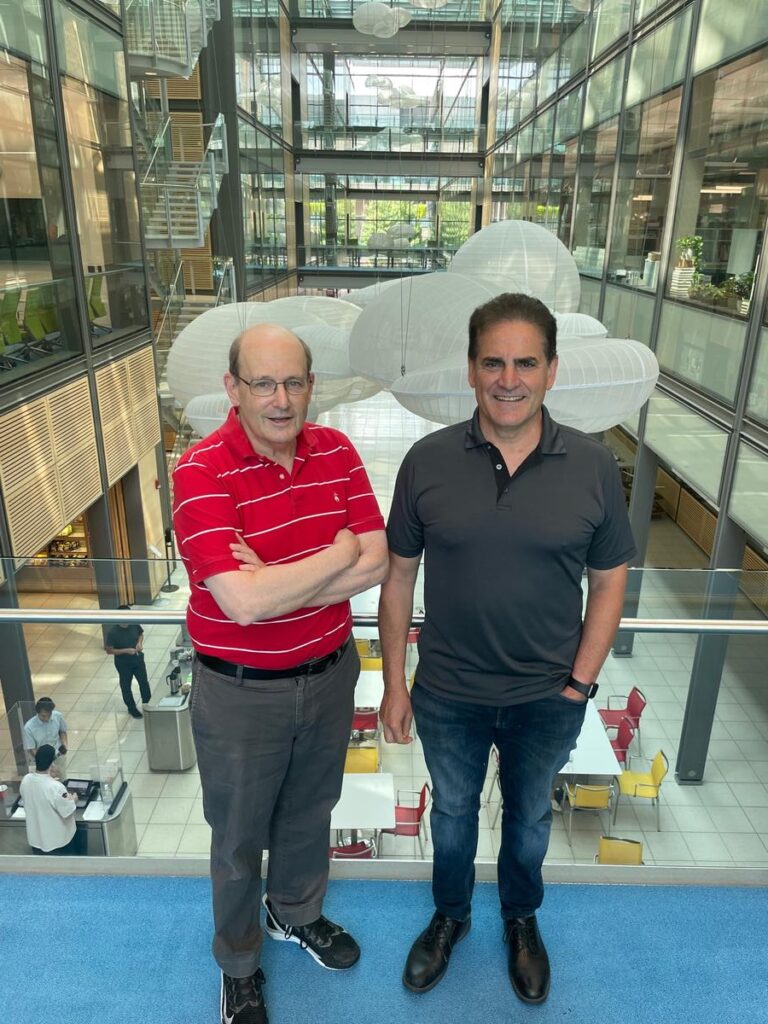
Paul Steinhardt, Albert Einstein Professor in Science and Professor of Physics (left); and Salvatore Torquato, Lewis Bernard Professor of Natural Sciences, Professor of Chemistry.
COMMENT FROM CO-PI PAUL STEINHARDT, ALBERT EINSTEIN PROFESSOR IN SCIENCE AND PROFESSOR IN PHYSICS: “Particle propagation in disordered one-dimensional materials in which the disorder is ‘stealthy hyperuniform’ (a special subclass of hyperuniformity) can extend arbitrarily far despite the disorder. To be precise, Anderson’s proof that localization, or trapping, occurs remains true in the hypothetical case of an infinite chain (wire) of atoms but for any finite-size chain there is a range of energies for which the particles can propagate from end to end. We called this ‘effective delocalization,’ since real materials are finite.
“A similar result may apply to the propagation of waves (rather than particles). For example, we have done a numerical study of the propagation of light waves through a stealthy hyperuniform sequence of parallel slabs of material with high refractive index and found what seems to be perfect transparency for a range of frequencies for finite-size systems, despite the disorder.”
COMMENT FROM FIRST AUTHOR CARLO VANONI, POSTDOC, DEPARTMENT OF PHYSICS: “I knew that Sal and Paul had studied the role of stealthy hyperuniform disorder on the optical properties of two-phase media. I was wondering if something similar happens for Anderson localization. So together with Sal and Paul, we started discussing it with my previous collaborator and friend Boris Altshuler, an expert in the field, and we started looking at the 1D Anderson model. The model is analytically tractable, so I made the analytic calculations and numerical simulations to verify the expectations, and they matched perfectly.”

Carlo Vanoni, postdoc in the Department of Physics and first author on the research.
“The results have very interesting practical applications. In any lab experiment, one would be dealing with a finite-size system. So our finding says that disorder is not necessarily prohibiting quantum transport. In 1D, this was the answer everybody would have guessed, but stealthy hyperuniformity provides a way to design disorder so that quantum transport is present even in large systems. This opens the door to the design of disordered structures with target physical properties in the quantum realm.”
FUNDING: This research is supported by the Army Research Office under Cooperative Agreement No. W911NF-22-2-0103.