

Alumni Q&A with Iraklis Pappas: “What is the value that You + AI brings?”
How does a graduate student go from research in inorganic chemistry to overseeing artificial intelligence at Colgate-Palmolive? It seems like an unconventional pathway to everyone except Iraklis “Kli” Pappas, who earned his Ph.D. under Paul Chirik and is now one of the next-generation scientists urging AI on an uncertain world.
Pappas grew up in South Jersey. He got his undergraduate degree in chemistry from Rutgers University, interning for Colgate-Palmolive along the way and working for the company again after graduation. He started his doctoral degree with the Chirik Group in 2016, successfully defending in just four years.
Next, he returned to Colgate-Palmolive, working in machine learning, then data science, then AI, following what he characterizes as a sure throughline. Today, AI models developed by Pappas and his team inform nearly every product that moves through the consumer packaged goods company, from toothpaste to body wash to floor cleaners. So how did he do it? Pappas says it’s not about the science. Or not only about the science.
“I like chemistry,” he says, “but my first love is just learning things. My second love is the science.”
Enjoy our Q&A with Iraklis Pappas, Vice President of AI at Colgate-Palmolive.
WAS SETTING EXPECTATIONS IMPORTANT TO YOU AS A GRAD STUDENT?
The first week I got to Princeton Chemistry, I sat down with Paul and said, “What do you expect from someone in order to graduate and what do I need to deliver every year?” I was super clear coming in about what we were trying to do together. This is deeply coupled with the fact that I was coming from industry, so I was used to setting a working schedule and things that I had to deliver by day, by week, by quarter, by year. That helped me a lot because I knew that I needed to deliver this many papers a year at this level of journal or above and across this many projects. It’s impossible to set a rigid schedule when you’re doing research. But it is possible to set expectations.
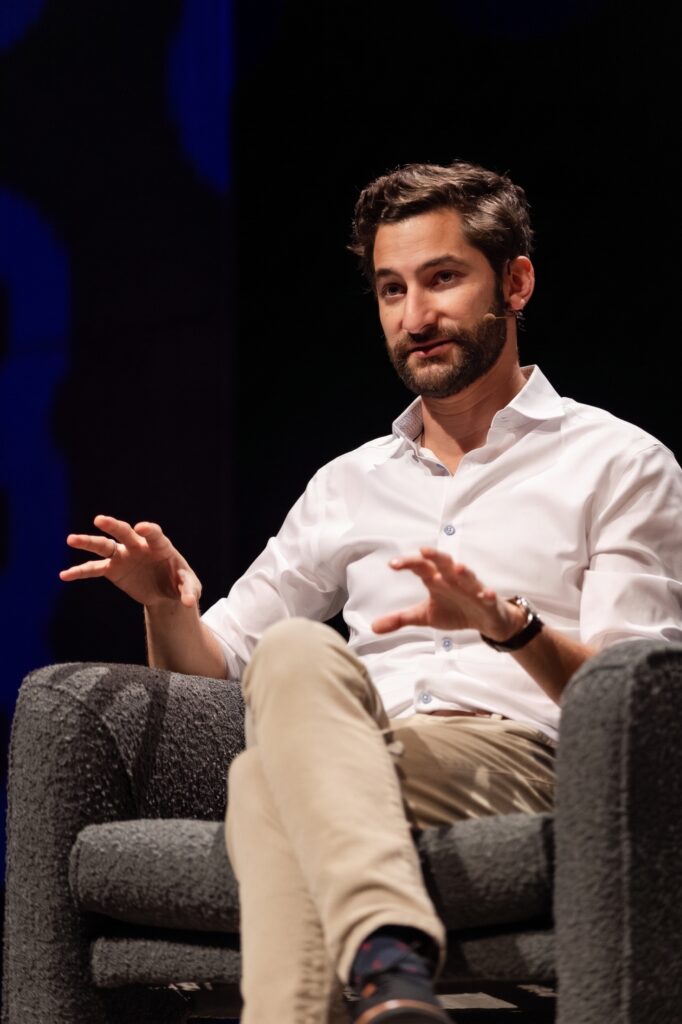
Iraklis Pappas, Vice President of AI at Colgate-Palmolive and former graduate student in the Chirik Group, at a speaking engagement in late 2025.
WHAT DID YOU WORK ON UNDER CHIRIK?
Paul has had a long-term research area focused on nitrogen fixation; that is, turning atmospheric nitrogen into ammonia. His research has of course shifted over the years, but nitrogen fixation has been a long-standing interest. His group also works a lot with industry and pharma on earth-abundant metal catalysis. I worked on both – mechanistic studies of nitrogen fixation and earth-abundant catalysis creating silicon materials.
WOULD YOU CALL IT A ‘PIVOT,’ MOVING FROM INORGANIC CHEMISTRY TO AI?
In the Chirik Group, I was doing fundamental metal chemistry and a lot of that research was looking at the energetics – the thermodynamics and kinetics – of how reactions happen. Consumer packaged goods companies like Colgate-Palmolive are responsible for making sure our products meet expectations and are stable throughout their lifetime on the shelf.
We have huge volumes of info on all the products we’ve made: the ingredients that went in and what they look like. And I thought, well, surely we can do some of these basic chemical calculations, these thermodynamic calculations to predict product stability. Why do we need to go into the lab and measure all these things ? So I tried applying literally the same thermodynamic work that I did in grad school. It didn’t work so well.
But at that time new machine learning techniques were becoming available so I realized that, wait, you don’t have to do all of this from first principles. You can take machine learning models and those can learn some of the principles that you don’t have in a textbook. So I started working on ML models to predict what will result if a scientist combines certain ingredients together: What will the consumer attributes be? Will it be stable on-shelf? Will it taste good? Will it feel good? Colgate-Palmolive has since had a number of patents granted on that work.
Many of the products we develop globally across brands and categories go through this ML engine, and underneath that ML engine we use thermodynamic calculations. Which is exactly what I worked on in grad school.
HOW DID AI FOLLOW FROM THAT?
We established a team to support the machine learning work and when ChatGPT came out, many of the people who were supporting the machine learning projects were also qualified to work on generative AI. So the team’s remit over time has evolved to keep up with changing technology. There’s a direct line: I left grad school thinking about thermodynamics and went into industry thinking about the intersection of thermodynamics with ML, and then the skills and team capabilities I developed around ML made for a natural transition into AI.
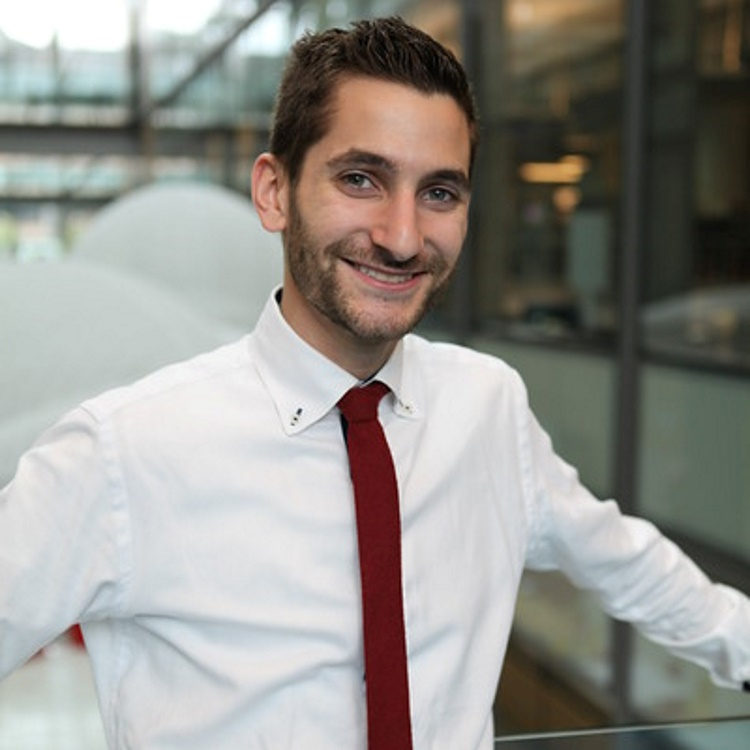
Pappas as a Ph.D. candidate at Frick Lab. He defended in 2016 after just four years.
DO YOU SEE AI AS AN ESSENTIAL TOOL FOR SCIENTISTS?
I just think that if people don’t grab the bull by the horns and own the way they use AI to bring value, then AI will be a tidal wave that will sweep past them. Everyone needs to figure this out: what is the value that You + AI brings? You can’t just wait for AI to come into your workflow where the only thing you do is click “go.”
AI has superhuman abilities in the sciences. Full Stop. When I was in grad school, if I had a question about chemistry that was in a different subfield – a deep question – I had no way to answer it without time-consuming desk research. That’s a huge amount of friction to gain knowledge. Meaning you have to ask fewer deep questions because there simply is not time to do the research. Now, large language models have the knowledge of a Ph.D. in any field. So if I’m a researcher, that makes me much more powerful and requires me to be much less specialized..
ARE SOCIETAL CONCERNS ABOUT AI LEGITIMATE?
Ultimately, the work of a scientist is to solve human problems. And people are going to be the best judges of what is a meaningful human problem and what counts as a meaningful solution. All the rest of it is, how do I execute that? How do I go deep enough or wide enough to solve that problem? AI can help scientists go deeper and wider.
What I worry about most is that some people will let history roll past them because of fear or misinformation. Meanwhile they have access to the most complex object built in human history – by definition, because it’s trained on all human knowledge on the internet – but because of apathy, fear, or misinformation, people feel like it’s not useful for them. How could that be? This is the dream of a scientist. This is the infinite library at your fingertips.
Newcomers to AI need to find one useful thing that AI can help them. The best way to do that is literally find someone else who has figured that out and done useful things and ask them, can you show me something useful? Then you’re off to the races.
DO YOU HAVE ANY ADVICE FOR GRAD STUDENTS DURING THIS TIME OF TECHNOLOGY AND SKEPTICISM?
Embrace the strange. Embrace the weird. LLMs have been described as aliens. We don’t know how they work. They have brains, kind of, but no one knows how they’re going to develop or how we’ll be interacting with them. Everyone will be looking to the best and brightest people to give them the answers. So the best and brightest will have to start with the questions.
That’s exactly the skill you learn in grad school, how to ask meaningful questions. So people going through academia now need to push the rest of the structure around them to rethink how work is done in relation to them and what value they bring, and then realize that the training they’re getting is on asking meaningful questions. That is exactly the training that is going to make them able to have an impact with AI in grad school and out of grad school. That’s what others are going to be looking for them to do. So don’t underestimate that skill.
No one has the answers. Business and society are looking to you to use your graduate training and come up with better answers than we have today. Don’t let this historical moment pass you by. Embrace the weird, make AI your own, and bring that into the world. Your family, friends, and colleagues will be looking to you for thought leadership – don’t shirk that responsibility.