

David MacMillan Awarded the 2027 Arthur C. Cope Award
David MacMillan, the James S. McDonnell Distinguished University Professor of Chemistry, has been awarded the prestigious 2027 Arthur C. Cope Award by the American Chemical Society (ACS) in recognition of extraordinary achievement and contributions to the field of catalysis.
The Cope is one of the highest international honors in organic chemistry, considered a “career” award that focuses on lifelong achievement rather than one specific technology. Cope Awardees are also largely determined by peers, reflecting an individual’s high standing among colleagues and other experts in the field. (It is distinguished from the Arthur C. Cope Scholar Awards, 10 of which are given out each year to encourage excellence in the field; MacMillan won a Cope Scholar Award in 2007.)
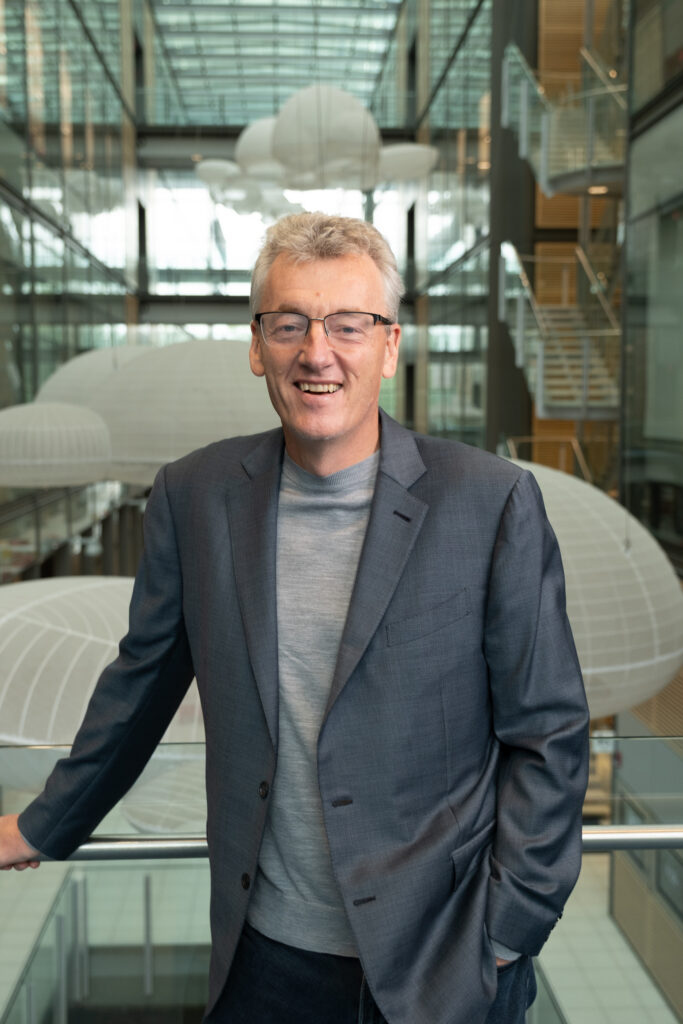
David MacMillan, the James S. McDonnell Distinguished University Professor of Chemistry and recipient of the 2027 Arthur C. Cope Award.
“I feel incredibly privileged and incredibly humbled. It’s another of those moments in life,” said MacMillan, who was jointly awarded the 2021 Nobel Prize in Chemistry. “Coming up as an organic chemist, I would see Cope Award winners and think, these are like gods of the organic chemist world. So when the ACS president called me up to tell me I had won it, it was really surreal. My two previous bosses won it: David Evans at Harvard and Larry Overman at UC Irvine, and these are two of the greatest chemists who’ve ever lived. Also, Peter Dervan, Stuart Schreiber, Peter Schultz, Barry Sharpless, and E.J. Corey. It’s like a ‘Who’s Who’ of organic chemists. I can’t imagine myself in this group,” he said.
“This is also an award for my group’s research that represents the creativity, dedication, and innovation of all the members of my lab past and present,” said MacMillan. “It’s really their award, to be honest.”
The Cope Award consists of $25K and a medallion along with an unrestricted grant in the amount of $150K for research in organic chemistry. It was created in celebration of the life and chemical contributions of Arthur C. Cope, a highly influential chemist and former president of the ACS.
The ACS national awards for outstanding achievements in chemistry were announced last week in the ACS flagship journal, Chemical and Engineering News.
Contributions to the field
MacMillan’s contributions to the field of catalysis have had a worldwide impact, including the technology for which he was awarded the 2021 Nobel, asymmetric organocatalysis, a revolutionary means of designing and building small organic molecules to drive chemical reactions more selectively and in a more environmentally benign fashion; and advancements in photoredox catalysis, a powerful strategy for the activation of small molecules that uses visible light to drive reactions.
“I always say that I didn’t choose organic chemistry. It chose me,” MacMillan said. “I was trying all these subjects and nothing was working and I wasn’t doing very well. And then I was introduced to this field and it was like, okay, here we go.
“I’ve been so privileged to end up doing this, to end up loving the thing that is useful for the world. It’s good for the soul. And everyone in the world is chipping in. We’re all chipping in our little bits to make a better life for everyone. That’s the point. That’s the goal.”
MacMillan was born in Bellshill, Scotland, in 1968, and received his B.Sc. from the University of Glasgow in 1989 and his Ph.D. from the University of California-Irvine in 1996. He began his independent research career as a member of the chemistry faculty at the University of California, Berkeley, in July 1998. He joined the department of chemistry at Caltech in 2000. He came to Princeton in 2006, and was named the James S. McDonnell Distinguished University Professor of Chemistry in 2011. He served as chair of the Department of Chemistry from 2010 to 2015.
He has won numerous prizes and awards, including most recently an honorary fellowship in the Royal Society of Chemistry (2026), and the F.A. Cotton Medal for Excellence in Chemical Research (2024). He was elected to the National Academy of Sciences in 2019, and in 2022 was knighted by the late Queen Elizabeth II.
Recipients will be honored at an awards ceremony in conjunction with the ACS Spring 2027 meeting in New Orleans next March.