

Hammes-Schiffer Wins APS Langmuir Award
Sharon Hammes-Schiffer, the A. Barton Hepburn Professor of Chemistry, has been selected to receive the 2027 Irving Langmuir Award in Chemical Physics from the American Physical Society (APS) in recognition of outstanding interdisciplinary research in chemistry and physics.
The award recognizes Hammes-Schiffer’s insights into the quantum nature of protons in molecular, biological, and material environments, including new theories of proton-coupled electron transfer and proton-coupled energy transfer, as well as the invention of the nuclear electronic orbital (NEO) method for quantum chemistry and dynamics.
“I am honored to have been selected for this award, especially because it bridges chemistry and physics,” said Hammes-Schiffer. “I have always considered myself to be on the boundary between these two fields; my group is highly interdisciplinary, combining chemistry, physics, biology, and computer science. It’s exciting to be recognized at this boundary.”
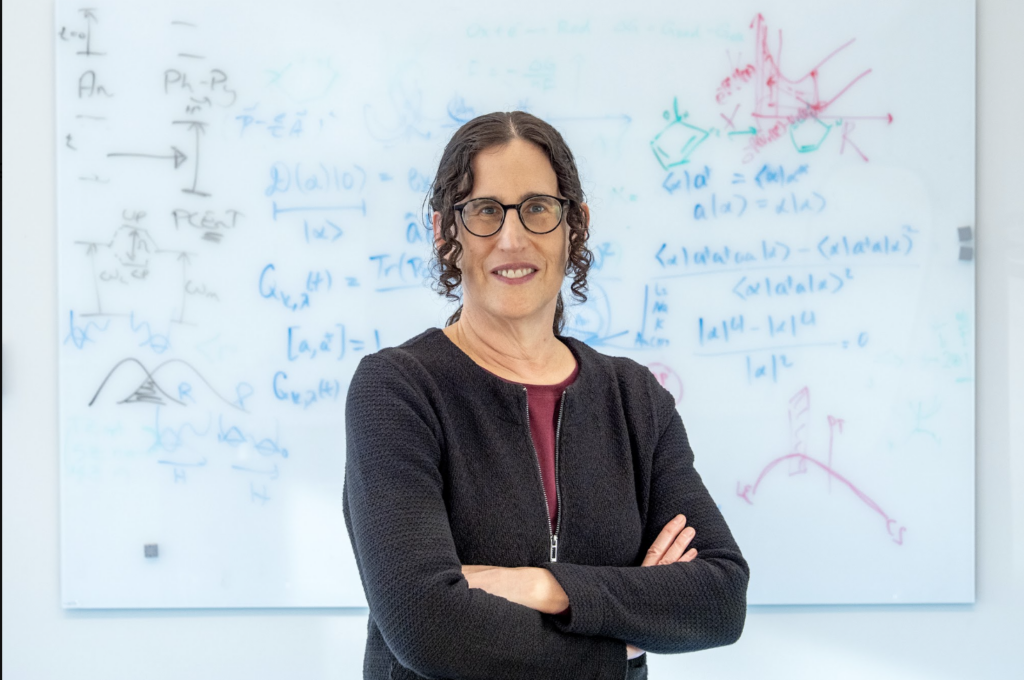
Sharon Hammes-Schiffer, the A. Barton Hepburn Professor of Chemistry.
The Langmuir award was established in 1964 by the GE Foundation to honor the accomplishments of Irving Langmuir, a chemist, physicist, and metallurgical engineer who received the 1932 Nobel Prize in Chemistry. The biennial APS Langmuir (in even years, the American Chemical Society selects the awardee) includes a cash prize and a certificate citing the recipient’s contributions, along with a travel stipend to the Society’s global summit for bestowal.
The Hammes-Schiffer Group at Princeton Chemistry develops theories and computational methods and applies these approaches to chemical and biological systems.
Hammes-Schiffer, who has been with the Department since 2024, has been investigating protons since the 1990s when scientists were developing quantum mechanical theories to study electrons, but much less attention was given to protons. She was inspired, she said, by experiments showing that protons could also behave quantum mechanically, a prime example being that protons were shown to tunnel in certain enzymes.
“I realized that we needed to develop theories to understand the quantum nature of protons and to explain how behavior such as hydrogen tunneling can significantly impact chemical reactions in molecular, biological, and material environments,” said Hammes-Schiffer.
In addition to her pioneering theories of proton-coupled electron transfer, Hammes-Schiffer is also known for her invention of the NEO method. The NEO method was developed to describe specific nuclei, in this case protons, quantum mechanically, on the same level as electrons.
“When I started developing the NEO method, many people told me that I was wasting my time because it would never be useful for studying interesting systems. I persisted working on NEO through the years. We figured out how to incorporate electron-proton correlation, which is essential for describing how electrons and protons interact with each other.
“Since then, the NEO method has become accurate and efficient enough to study interesting systems and is now accessible to the broader scientific community. I am excited to see that other groups are now using it to study systems that would have been out of reach five years ago. With this level of attention from other groups, as well as our own work, I am expecting the NEO method to continue to expand and hopefully to become mainstream.”
Hammes-Schiffer is a summa cum laude graduate of Princeton’s Class of 1988 and holds a Ph.D. from Stanford University.
The APS Global Physics Summit will be held in April in Georgia.