

Summer Series: Papers We Love with Marissa Weichman
The Princeton Department of Chemistry publishes nearly 300 journal papers each year. Some of them make quite a stir. Others glide along under the radar with citations that ebb and flow based on whether a particular field is in play. Still others lodge themselves in their authors’ minds as representative of a lab’s greater mission.
This summer, we’re going to highlight papers in this third group; the ones that were magical, even formative in a faculty member’s research program.
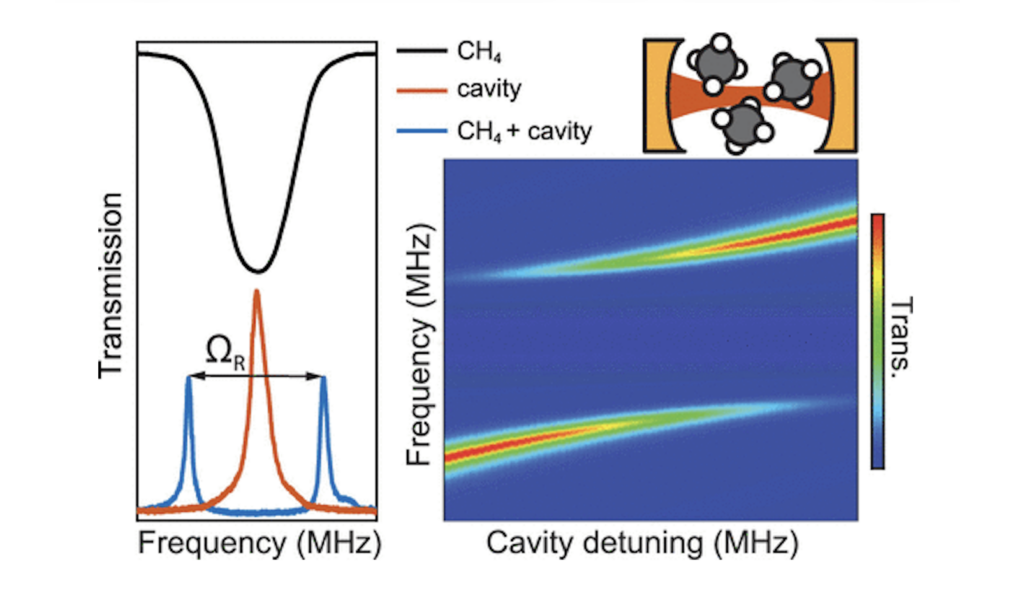
Like this one from Assistant Professor of Chemistry Marissa Weichman: Rovibrational polaritons in gas-phase methane, which appeared in the Journal of the American Chemical Society (JACS) in March 2023 under authors Adam Wright, Jane Nelson, and Marissa Weichman.
Enjoy our brief Q&A below.
Why is this paper important to your lab?
I am very proud of this paper because it has since become one of the Weichman Lab‘s central contributions in the field of molecular polaritonics: we were able to establish the first demonstration of reaching the strong light-matter coupling regime in gas-phase molecules. Polaritons are hybrid light-matter excitations that arise when a bright optical transition of an ensemble of molecules is resonantly matched to the frequency of a confined optical cavity mode. Polaritonic molecules have drawn recent intense interest due to reports of intracavity reactions and photochemistry proceeding with distinct rates than free-space molecules, though basic mechanistic understanding remains lacking.

Assistant Professor of Chemistry Marissa Weichman
What is the takeaway message?
One major takeaway is that we showed in this paper that it is in fact possible to engineer polaritons in gas-phase molecules. It is not experimentally trivial to reach this regime, but we were able to harness tools from precision measurement and cavity-enhanced spectroscopy in order to do it. Another major outcome from this work is that it taught us just how well classical optics works to simulate the spectroscopy of polariton systems, providing a very simple, logical interpretation of our data. We have since explored this much further in a 2025 perspective article in Chemical Physics Reviews.
What question did you want to answer?
While it has historically been very fruitful to examine new problems in chemical physics in the gas phase (where things are simple, clean, and in isolation from the environment) before extension to condensed phases, polariton chemistry had so far skipped this step! Polaritons are very well established in solution and in solid-state systems, but had not been previously reported in isolated gas-phase molecules until this effort. We really wanted to build this platform, which would let us answer basic questions in molecular polaritonics with a high degree of clarity and experimental control, and in a way that would be very complementary to other approaches in the field.
How does this paper contribute to the broader field?
Our ongoing objective is to use this new experimental platform to develop mechanistic understanding and predictive capabilities for how molecules behave under strong light-matter coupling. We have very recently expanded upon the initial demonstration of gas-phase strong coupling in two new directions. This first paper achieved strong coupling of a vibrational transition of methane; we have now also achieved electronic strong coupling of individual, resolved rovibronic transitions of molecular iodine, which opens new opportunities to tackle polariton photophysics and lasing with this platform (arXiv preprint 2602.09243, 2026).
In parallel, we have implemented time-resolved nonlinear spectroscopy of strongly coupled gas phase molecules. Making time-resolved measurements is an important next step for this platform, both to connect our gas-phase work to the larger body of ultrafast condensed-phase literature and to study molecular dynamics under strong coupling.