

Richard Kang Awarded Beckman Fellowship
Richard Kang, a postdoctoral fellow with the Hammes-Schiffer Group, has been awarded a 2026 Arnold O. Beckman Postdoctoral Fellowship in Chemical Sciences, one of just 18 young scientists nationwide to receive this distinction.
The award is given annually by the Arnold and Mabel Beckman Foundation to postdocs who contribute to the Foundation’s mission of supporting basic research in chemical science and chemical instrumentation, and who have the highest potential for success in the field.
The fellowship comes with a two-year stipend (with the possibility of a one-year extension). It is intended to serve as a catalyst for postdocs looking to shift from mentored status to outstanding independent researchers.
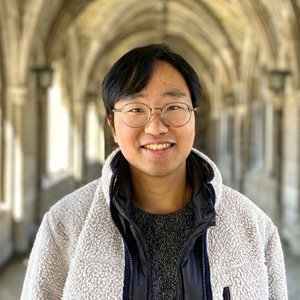
Richard Kang, postdoc in the Hammes-Schiffer Group and recent awardee of an Arnold O. Beckman Postdoctoral Fellowship.
“I was riding on a bus crowded with undergrads when I heard the news about the fellowship,” said Kang. “This is one of the most prestigious fellowships I could get, so I really didn’t think this would happen. When I got the news I felt like, oh, I really have something to celebrate.”
Kang arrived at Frick Lab earlier this month. He will be working to develop the next generation of nuclear-electronic orbital (NEO) methods to simulate both electrons and protons quantum mechanically, and to enable high-accuracy computational design of heterogeneous catalysis.
“The new NEO methods will rigorously incorporate environmental effects, such as electrodes, pH, and temperature. The new methods will also be more cost effective, increasing the size of systems that can be simulated on a computer,” Kang wrote in his fellowship proposal.
He aims for his research to yield new perspectives on the role of nuclear quantum effects in controlling the function and stability of heterogeneous applications.
“Richard has an ideal background for my group, with experience in theoretical method development, coding, and applications to experimentally relevant systems,” said A. Barton Hepburn Professor of Chemistry Sharon Hammes-Schiffer, Kang’s mentor. “This background will allow him to pursue fundamental theory development and also to collaborate with experimentalists studying heterogeneous catalytic processes.
“His research focus in my group will be on developing theoretical methods for including nuclear quantum effects, such as nuclear delocalization and tunneling, into simulations of heterogeneous catalysis.”
Kang was born in Pennsylvania but spent most of his childhood in South Korea. He got his undergraduate degree in chemistry at Cornell University, where he pursued year-long research in the lab of Robert DiStasio post-graduation. Afterwards, he finished his Ph.D. at the University of California, Berkeley, under the mentorship of Martin Head-Gordon.
“At Berkeley I was of two equally divided interests,” said Kang. “On the one hand I was mostly focused on computational modeling of catalysis occurring on surfaces, and that’s actually what motivated me to reach out to Sharon. The other was doing theoretical development, coming up with chemical theory for ultrafast processes and X-ray spectroscopy.”
Kang said he is looking forward to his new home in Princeton partly because of the snow.
“I like the mild California climate, but I also am missing a bit of coldness and snow. I generally like the New England climate, and four seasons,” said Kang. “I’ve never been to Princeton before but I’ve heard good things about how it’s a lovely town. It is also quite close to New York City, so I think it’s going to be a great place to live.”
Later this week, Kang will travel to Irvine, CA for the Annual Beckman Symposium.