

Roque Lab’s Hailey Hendricks wins Emergent Leader Award
Hailey Hendricks, a third-year graduate student in the Roque Lab, was recently selected for a Pfizer WCC Emergent Leader Award as part of the 2026 ACS Spring Conference in Atlanta, Georgia.
Administered by the ACS Women Chemists Committee, the award recognizes up to eight outstanding individuals nationally for their work each year in the areas of organic chemistry, synthetic methodology, total synthesis, medicinal chemistry, computational chemistry or chemical biology.
Hendricks presented a talk at the conference on her research, Latent ligand-centered radicals enable photoinduced nickelCF3 cleavage.
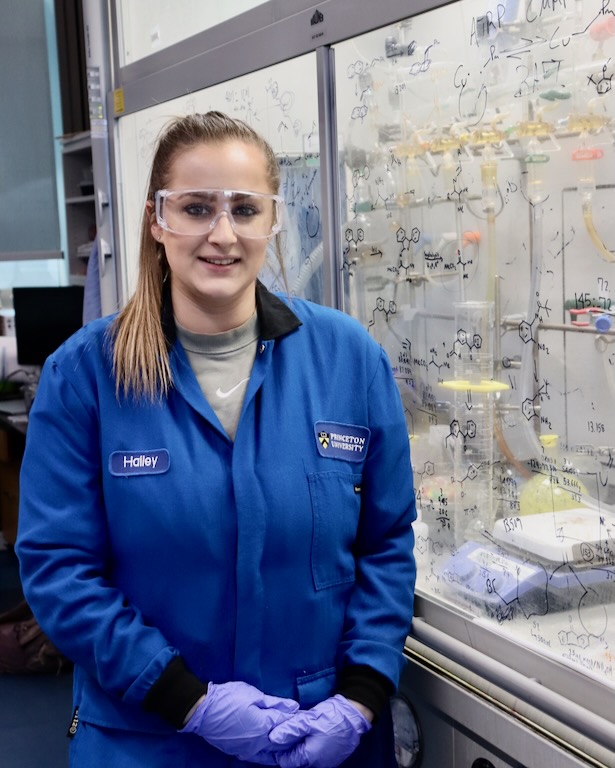
Hailey Hendricks, a third-year graduate student in the Roque Lab.
“This is really, really exciting for me,” said Hendricks. “I’ll be honest, coming from the University of Rhode Island as an undergraduate to a place like Princeton, I was absolutely terrified. Most of the other grad students here did not come from state schools. There was a big learning gap in the beginning because everyone around me seemed familiar with content that I was seeing for the first time.
“But I pushed through and I worked really hard. I learned that it doesn’t matter where you start, it matters how hard you work and how hard you want to get there. So to be recognized in this way is really exciting.”
Roque credits Hendricks with the quick success in getting his lab off the ground after his appointment as assistant professor in 2023. For months, Hendricks was the only graduate student building out the lab with him. Today, the lab has nine grad students and three postdocs.
“I was thrilled to hear about Hailey being awarded the Pfizer Emergent Leader Award,” he said. “Hailey has been there since the start of our lab, has fearlessly carved out an entire research direction in our group that is extremely exciting, highly interdisciplinary, and requires someone who is not afraid to take on bold challenges. She is a natural leader, and I am happy to see others recognizing this.”
At the ACS conference, Hendricks presented her work as a merger of organometallic chemistry and photophysical chemistry. There, she introduced the concept of stimuli responsive ligands, research she has been working on since she joined the lab.
Hendricks’ love of science started early and in earnest. While in second grade, for example, she accompanied her mother to night classes at a local community college in Rhode Island. Afterwards, she would ask her mother to prepare worksheets on the subject matter – anything from parrots to geology. Science was “always” going to be her field, she said.
“I just like to build things in general. Both concepts and ideas, but also physically,” she said. “So, for example, we have all this instrumentation. Things happen. It breaks. And the joy of being part of a new lab is, well, you have to fix it. And if you don’t know, then you have to figure it out.”
Hendricks received her undergraduate degree in chemistry in 2023 from the University of Rhode Island. She completed a Princeton Chemistry REU remotely in 2021 under the mentorship of Arthur Allan Patchett Professor in Organic Chemistry Erik Sorensen. The following summer, she had an internship at Merck in Boston in Discovery Chemistry.
Hendricks has not yet decided if she’ll take her own natural leadership into industry or academia. But to date, she has already mentored three undergraduates for whom she held “very high expectations.” One of them started his Ph.D. work at Cal Tech last fall.