

Fall 2026 Colloquium Honors Marissa Weichman
The Department of Chemistry is pleased to announce the Fall 2026 Colloquium honoring Assistant Professor Marissa Weichman. The event includes a faculty talk and reception open to the campus community.
Weichman’s presentation is titled “Through the Looking Glass: The Spectroscopy, Dynamics, and Chemistry of Molecules in Optical Cavities.” The colloquium will take place on Wednesday, Sept 23 at 4:30 p.m. in Taylor Auditorium, Frick Lab.
Weichman is a physical chemist whose research uses fundamental chemical physics and spectroscopy to probe the details of molecular processes and develop new ways to steer these processes using light, a holy grail of the subfield.
As a professor at Princeton Chemistry over the past six years, Weichman has made several important contributions to the study of molecular polaritonics, including the first demonstration of reaching the strong light-matter coupling regime in gas phase molecules.
In addition to this core work, Weichman won a Packard Fellowship in 2023 for another research direction with a proposal to study atmospheric aerosols and their potential role in climate change through the development of new spectroscopic tools.
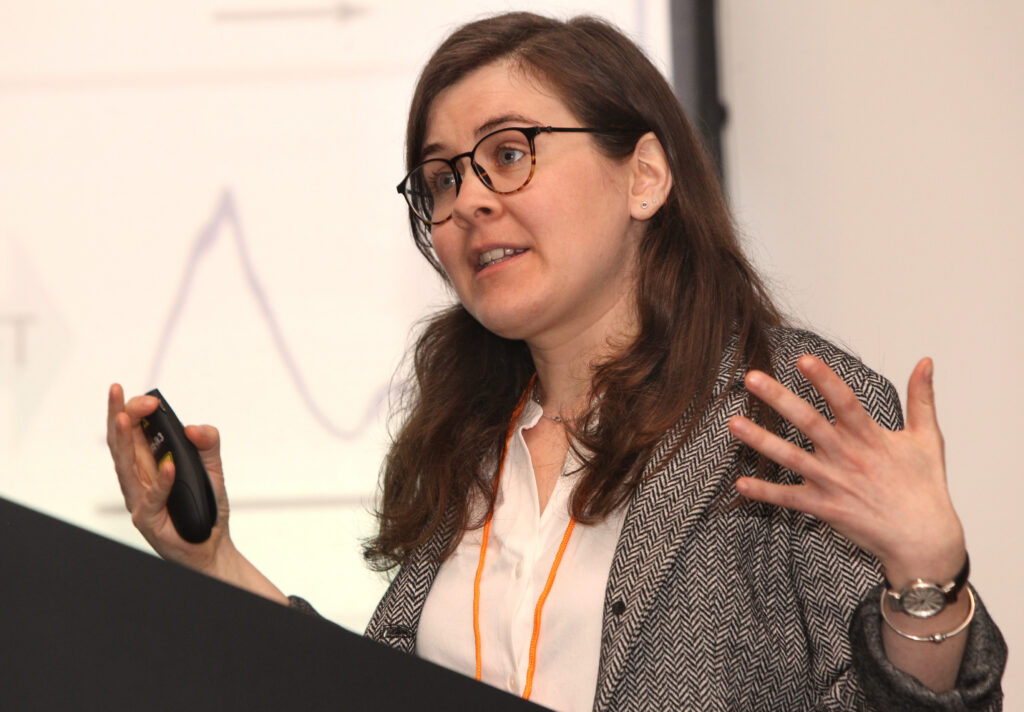
Assistant Professor Marissa Weichman.
Weichman’s colloquium presentation will be a broad overview of her research with an emphasis on polariton chemistry.
“My lab’s research program is centered in chemical physics and light-matter interactions, drawing techniques and inspiration from atomic, molecular, and optical physics. In this talk, I will discuss our pursuit of new schemes to steer chemistry using light and some of the new spectroscopies we are developing to better probe the structure and dynamics of complex chemical systems,” said Weichman.
“Much of our recent work has demystified how molecules behave under strong light-matter coupling. I will highlight in particular how we have pioneered the first platform for gas-phase molecular polaritons and established classical cavity optics as a unifying language and interpretative tool for the linear and nonlinear spectroscopy of polaritonic systems.
“I will also discuss our work examining the ultrafast chemistry and dynamics of condensed-phase molecules under vibrational and electronic strong coupling, yielding fundamental understanding of polariton behavior consistent with our classical cavity optics framework. Finally, I will mention our ongoing work to deploy precision and cavity-enhanced spectroscopies to resolve the quantum structure of large, astrochemically relevant molecules and constrain the microphysics of atmospheric aerosols that contribute to radiative forcing of Earth’s climate,” she said.
Weichman joined Princeton Chemistry in 2020 from the University of Colorado, Boulder, where she was a NIST NRC postdoctoral fellow. She received her B.S. in Chemistry from the California Institute of Technology, and her Ph.D. in Chemistry from the University of California, Berkeley.
Along with her position in the Department of Chemistry, Weichman is associated faculty with the Princeton Quantum Initiative, the Princeton Materials Institute, the High Meadows Environmental Institute, and the Princeton Plasma Physics Laboratory.
Weichman Lab papers of note include:
• A. D.Wright, J. C. Nelson, and M. L. Weichman, “Rovibrational polaritons in gas-phase methane”, J. Am. Chem. Soc. 145, 5982 (2023).
• A. M. McKillop and M. L. Weichman, “A cavity-enhanced spectroscopist’s lens on polaritons”, Chem. Phys. Rev. 6, 031308 (2025).
• L. Chen, A. M. McKillop, A. P. Fidler, and M. L. Weichman, “Ultrafast optical modulation of vibrational strong coupling in ReCl(CO)3(2,2-bipyridine)”, Nanophotonics 14, 5437 (2025).
• A. M. McKillop, L. Chen, A. P. Fidler, and M. L. Weichman. “Direct readout of excited state lifetimes in chlorin chromophores under electronic strong coupling.” J. Am. Chem. Soc. 148, 9, 9737 (2026).
• N. Baradaran, D. Charczun, T. Nambiar, M. Zou, K. F. Lee, M. E. Fermann, M. L. Weichman. “Long-wave mid-infrared cavity-enhanced frequency comb spectroscopy of cold, complex molecules.” Opt. Express 34, 6751 (2026).