

Chirik Lab’s Tianyi Zhang Wins Jacobus Fellowship, among University’s Most Prestigious Honors
Tianyi Zhang, a fourth-year graduate student in the Paul Chirik Group, has been named a 2026-27 Porter Ogden Jacobus Fellow, acknowledging outstanding performance and professional promise through one of Princeton University’s highest honorifics.
Zhang was selected for his research in organometallic catalysis. His thesis title is Understanding Spin and Oxidation State Modulation in Organometallic Iron Catalysis.
Zhang is one of four grad student Jacobus Fellows announced by the Graduate School this month.
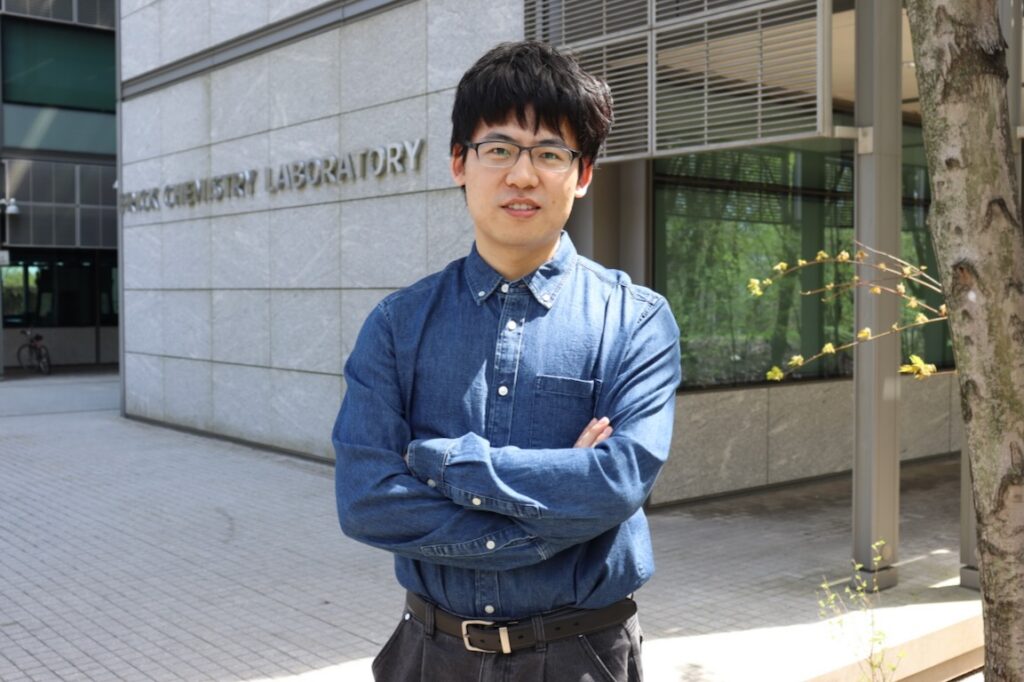
Fourth-year graduate student Tianyi Zhang, who has been named a Jacobus Fellow.
“I’m really, really thrilled because I know this is a highly prestigious award,” said Zhang. “I am grateful for the financial support provided by this fellowship, which also allows me to explore more challenging and potentially long-term projects in earth-abundant metal catalysis.
“It encourages me to double up on my efforts, and spurs me to forge ahead and do a lot more in terms of independent exploration. I’m grateful for this opportunity and very humbled by it.”
Paul Chirik, the Edwards S. Sanford Professor in Chemistry, said Zhang came to his lab four years ago with an encyclopedic command of chemical literature and broad experience from his undergraduate research. He was able to immediately take on challenging work at the core of the lab’s mission: developing iron compounds to break and functionalize C–H bonds in organic molecules.
“Over the past few years, Tianyi has done a masterful job developing iron compounds that promote C–C bond formation from C–H bonds. One of the highlights of his thesis work has been uncovering the role of spin state of the iron center to promote these transformations. What has resulted is a ‘textbook’ understanding of how the oxidation state and the number of unpaired electrons on the iron center can be manipulated to promote reactivity.
“Tianyi is the kind of student who makes being a principal investigator especially rewarding,” Chirik added. “He is naturally inquisitive, works independently, asks probing questions that drive his project forward, and elevates the intellectual rigor of the entire research group.”
Zhang was a stand-out during his undergraduate career even among accomplished peers at the California Institute of Technology. There, he earned a degree in chemistry in the top 5% of his class and was awarded the 2022 George W. Housner Prize for Academic Excellence and Original Research. He has authored seven papers as lead author, and was named a 2025 Johnson & Johnson Graduate Research Symposium Scholar.
The Jacobus Fellowship was established in 1905 by Clara Cooley Jacobus and is the University’s top honor for graduate students in their later years of study. The award includes full tuition and health plan fees for one year along with a stipend. It is one of two Fellowships received in the Department of Chemistry this month, including a Charlotte Elizabeth Porter Fellowship for Jane Nelson of the Weichman Lab.
Iron catalysis for future solutions
Chemists use catalysts to spur, or catalyze, chemical reactions that otherwise might take a great deal of time and energy to execute. Zhang’s research is rooted in organometallics, the science of using metals for highly efficient catalysis. He sees his work designing iron catalysts as complementary to historical reactions that rely on precious, less-environmentally sustainable metals like palladium and iridium. These processes are well understood and widely used in the synthesis of consumer and pharmaceutical products. Although iron catalysis is still in the early stages of development, its demand is increasing.
Iron, Zhang notes, is one of the planet’s most abundant elements, so understanding its fundamental properties as they relate to catalysis and C-H bond functionalization is essential. But his perspective is even more expansive. Zhang sees organometallic catalysis as a means to providing new materials and reactivities for more sustainable human activity far into the future.
“The goal of my Ph.D. is bridging the gap between what we know of precious metal catalysts and what we know about iron compounds in nature,” Zhang said. “With the precious metals, for example, electrons are typically paired up. But in the earth-abundant metals like iron, they can choose to be unpaired, which changes what we call the spin state. In some of our research, we have shown that by deliberately manipulating these spin states from low- to high-spin you actually unlock new reactivity that was not seen before with these precious metals.
“This is a really nice handle that provides a unique opportunity for us in designing new batches of catalysts and accessing a broader chemical space. How we can use these really abundant metals by understanding the exact mechanism behind their reactivity patterns can actually translate into designing catalysts that are more sustainable for future generations. I think there’s a lot of space in this area just waiting for us to explore.”
Zhang grew up in the prefecture of Changzhou in southeastern China. Both parents were engineers so a future in STEM was all but guaranteed, he said. He enjoys chemistry’s distinction as the central science because it provides a springboard from which he can embrace other fields like biology and physics.
Outside of the lab, Zhang plays competitive badminton and loves reading and watching science fiction. “Science fiction holds a more optimistic view and it’s nice to look into the future,” he said. “And because I do most of my work in gloveboxes, it is intriguing to think about different planetary atmospheres where maybe that wouldn’t be necessary.”
Zhang plans to pursue a career in academia.
An awards ceremony and reception honoring all Fellows will be held by the Graduate School in the fall term.