

Princeton Chemistry and AI: How we use it today
When scientists at Google DeepMind won the 2024 Nobel Prize in Chemistry for AlphaFold, an AI system that predicts protein structures from amino acid sequences, the future of AI was given an endorsement like no other. Particularly since the Nobel Foundation tends to honor technology that has been public for decades, AlphaFold’s prize just four years after its introduction spoke volumes about its transformative impact.
But what about AI in general? How do users feel about its potential and its drawbacks at this point? We spoke with five Princeton Chemistry professors for their perspectives.
Collectively, faculty are clear that AI has changed the field of chemistry forever. When and how that influence will manifest more broadly is still an unknown. But as expressed by Nobel laureate David MacMillan: “Anyone who says AI will never be able to do this or never be able to do that is really running the risk of being on the wrong side of history.”
Below are selected interview comments.
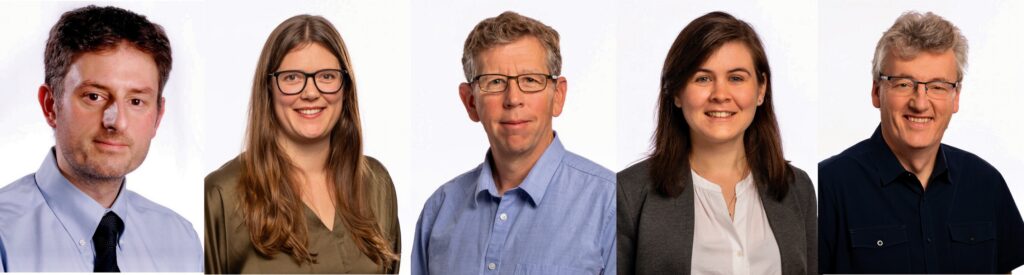
Mohammad Seyedsayamdost, Professor of Chemistry
“AlphaFold was trained on roughly 200,000 protein structures. A series of clever tricks were then used to augment the dataset and improve the algorithm’s predictive power. The result is remarkable, but the availability of a large, high-quality dataset was essential. In many areas of science, generating datasets of this scale is a lot more challenging. Take for example the field of antibiotics discovery. We don’t yet have the kinds of comprehensive datasets needed to train a model that can predict an antibiotic for a given drug-resistant pathogen. But when these datasets are available, AI can be extraordinarily powerful.”
“My lab is using AI in a number of ways. Of course, AlphaFold has become an almost daily tool for us. We work with a lot of new enzymes and are trying to unravel the reactions they catalyze, their substrate specificities and overall mechanisms, and structural information is central to all of these questions. We have also recently started using AI-based methods for uncovering the biological targets of natural products. Helping us with coding and programming is another major use. And in an exciting collaboration with the Zhong Lab at Princeton’s Department of Computer Science, we are tackling the long-standing challenge of small molecule structure elucidation. We recently published our first paper describing a program designed to determine molecular structures from NMR spectral data. In it, we outline the modeling approach, test the model on a small dataset, and demonstrate very good accuracy in structure prediction. We are now continuing to develop and refine the model.”
“The broader trend is clear: AI is becoming integral across many industries. In biomedicine, and especially pharmaceutical research, there is an enormous interest in applications ranging from diagnostics to lead discovery. I don’t see AI as replacing experimental science or ideating on its own. Rather, it is a powerful enhancer that can amplify human insight and accelerate discovery. I’m definitely excited to see where else AI can enhance and advance research efforts.”
Leslie Schoop, Professor of Chemistry
“AI has the potential to make us more efficient and be a good help in our day-to-day activities, but it also can make our job harder because it produces a lot of nonsense. For example, if you use it summarize the literature of an area you are interested to do research in, how is AI going to know what’s reliable? The peer review process is far from perfect and a lot of papers get published that aren’t correct. So if I ask AI, for example, to write a summary of all the materials that show a certain property, it might give you incorrect examples. I see a danger there. How would it know the answers are reliable? It would need scientists to know. We are currently collaborating to develop more reliable tools, but of course even if AI stops making things up, it is still susceptible to errors in the literature.”
“So far, I haven’t found an AI tool that is helpful for me as a materials scientist. When it comes to materials prediction, we outperform AI models very easily just doing what we’ve always done. So far all of the materials prediction stuff that came out has been proven to be nonsense. Unreliable. But I don’t think it’s impossible. And we are also working on it, trying to help collaborators to make better tools or finding ways how we can use AI for more reliable material prediction.”
“For coding it has been game changing.”
“It does feel like you’re at the beginning of something. I have a lot of distrust in AI right now. But I also think there’s potential and I would hate to miss out on that and only let other people figure it out and then jump on it when it’s better. So yes, I am participating in figuring that out. It’s kind of fun to navigate this now and try to find a way to try to make it work better.”
Tom Muir, Van Zandt Williams Jr. Class of 1965 Professor of Chemistry
“We use AlphaFold every day. Every single day. We use it for, what’s the predicted structure of this protein, what happens if we make a mutation to this protein, does it change the structure? It helps us design experiments that hitherto we probably wouldn’t be able to do or would have to solve the structure experimentally, which is extremely time-consuming and not always possible. For many things that we want to use it for, it works well.”
“It just allows us to ask better questions because we have a better sense of what we’re looking at now. In the old days, you’d be kind of flying blind or you’d have to experiment with the structure using XRays or CryoEM or NMR, which takes a long time and it’s not always possible for many proteins. So it’s really just been a revolution. Nothing short of it.”
“You have to know your question, right? AI doesn’t conjure up a question for you. Fundamentally, science is driven by having good questions. That part doesn’t change. This just helps you move towards an answer a little quicker. AI allows you to ask questions that you might not have asked before because it’s too risky; there’s no information or literature to suggest that this might be a good question. But now, you can run the program and get a datapoint to help you decide whether to go forward or not. That’s incredible.”
Marissa Weichman, Assistant Professor of Chemistry
“I think there’s a lot of hype right now. There are aspects in which AI will be a very useful tool like any new technology is down the line, but it’s about figuring out what the scope of use is today: when to apply it and how to use it smartly. So far, I don’t really see AI as a tool for discovery. I don’t think it gives you new ideas or new thoughts. We still very much need human brains and eyes to interpret and understand what we’re looking at. In terms of yielding scientific discovery through physical laws and intuition, the things that physical chemistry is based in, I don’t really see it.”
“I do think AI can be very useful for sorting through huge piles of data that are very tedious or impossible for a human to sort through. For instance, in analytical chemistry or astrochemistry where you are trying to identify a complex mixture of molecules based on tons of absorption lines, AI is being used to automate and speed up analysis.”
“The other place where I can see AI being useful, and where I’ve dabbled a little bit, is that it is very good at coding. I tell my students, sure, use AI to generate a first draft of your code, but then you need to go line by line and make sure you understand what it is doing.”
“In terms of training students, I think we just have to be very thoughtful with AI and I’m not sure we really know how to do that yet. For me, writing is a form of thinking, a way of getting my own thoughts clear. If you use AI to write for you, then you’re skipping the critical thinking step. I am concerned that AI might short circuit that critical piece, and erode how students learn in the classroom and learn to communicate and think as scientists.”
“AI is only as smart as the training data, and current large learning models are trained on the whole of human knowledge and text up to 2025. To keep making progress, we need a constant input of new human-created fodder. We as scientists need to continue to make new measurements and discoveries, think creatively, and add to this collective knowledge database.”
David MacMillan, James S. McDonnell Distinguished University Professor of Chemistry
“The issue is, we’re not very good at understanding what AI is going to do, but at the same time it’s a technological tool that’s constantly evolving. So it’s getting better. Anyone who says AI will never be able to do this or never be able to do that is really running the risk of being on the wrong side of history. Because at some point, it probably will. The larger question is, is it going to be next week or next decade or is it going to be in 50 years’ time? That is the issue humans are not very going at dealing with, predicting the timeline of the future.”
“I would say in chemistry, for example, if you need to optimize a process or a chemical reaction, AI is very, very good at that. You can run lots of experiments. It can do pattern recognition. It can show you how you make that chemical reaction for that process much, much better in a shorter timeframe. Or if you need to understand the structure of a complex molecule like an enzyme or protein, it can already do that at a level that was unimaginable 15 years ago. Where AI falls short at the moment is when it comes to inventing new chemical reactions of value to humanity. At the moment, AI is not going to invent a truly novel chemical reaction that has no precedent. Now, as time marches on that could change, but it’s not really happening right now. We still need that innovative streak, we need that creativity, that ‘out of left field’ idea to show up. At the moment, AI doesn’t do that.”
“I do think that it would be amazing to be in a world where discovery and finding new things got faster, no matter where it comes from. So getting our hands on innovations and ideas and concepts that do impact our quality of life – for instance, there could be so many more treatments for cancer than there ever has been in history. So what AI could do is establish problems for you to think about so that solving them would be world changing. For example, it might not come up with the specifics for a truly new chemical reaction, but it may suggest that if feedstock A could be combined with feedstock B, or C with D, it would be an amazing transformation for the world. In the ML world, this is known as conjectures. I think AI could be incredible at generating remarkable conjectures about what chemical reactions would be important, and for chemists to take these concepts and make them a reality through creative human invention. That’s a way to think about the possibilities with AI.”