

Weichman Lab’s Jane Nelson Wins Procter Fellowship
Jane Nelson, a fourth-year graduate student in the Weichman Lab, has been named a Charlotte Elizabeth Procter Fellow in the Natural Sciences for the 2026-2027 academic year. This Graduate School award honors research at the highest level of excellence.
Nelson was selected for her study of polaritons in the gas phase as part of the lab’s experimental work to validate theories of cavity-modified chemistry. Her thesis is titled: Gas-Phase Molecular Polaritons for Optical Control of Chemistry.
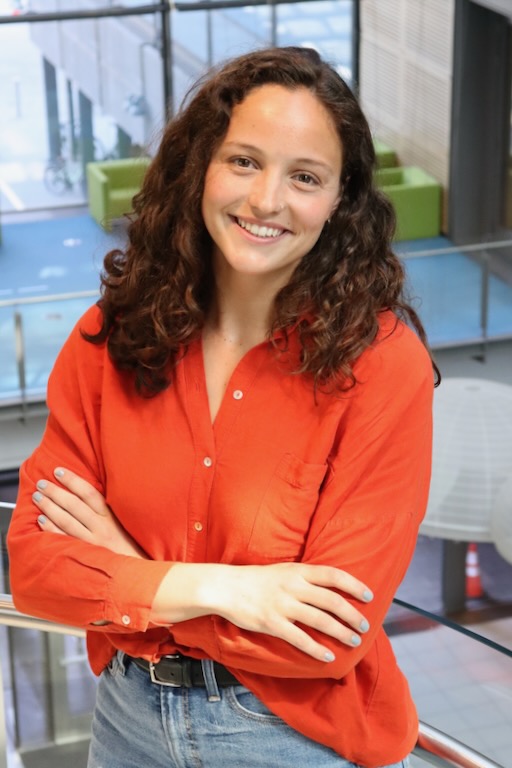
Jane Nelson, fourth-year graduate student in the Weichman Lab and a newly named Procter Fellow.
“I was shocked, honestly, because I never expected such a prestigious award,” said Nelson. “And then I was just really honored and moved that the family of Charlotte Elizabeth Procter wants to continue supporting Princeton students. It affirms my choice to pursue my graduate degree at a place that prioritizes support for fundamental research, especially when there’s not a product to drive or a disease to cure.
“The work I do is super fundamental, and it might not work. But the study of it will open new avenues. That I’m sure of. Or it will close certain avenues and allow researchers to go in other directions. It’s a recognition that the development of next-generation spectroscopy is going to come from fundamental research.”
Procter Fellows receive full University tuition and a 12-month premium stipend. The award was established in 1912 by the son of Charlotte Elizabeth Procter in her honor. Nelson’s is one of two Graduate School fellowships recently received by the Department of Chemistry, including a Porter Ogden Jacobus Fellowship awarded to Tianyi Zhang of the Chirik Lab.
Assistant Professor Marissa Weichman has been Nelson’s mentor for four years now. “It’s been a complete delight to work with Jane over the past few years, and I am thrilled to see her recognized with this award,” Weichman said. “Jane’s Ph.D. work has been dedicated to establishing a new platform to survey the behavior of polaritons in gas-phase molecules. Her contributions have helped lay the foundations of much of our group’s early research program in understanding molecular polaritons.”
Nelson studies gas-phase polaritons, hybrid light-matter states formed under strong cavity coupling, in order to find new ways to drive chemistry with light. The lab uses spectroscopy tools that researchers built themselves in the basement of Frick Lab. Their work has been able to demonstrate vibrational and electronic polaritons in the gas phase with molecules for the first time.
“So, it had been done with atomic gases, it had been done with liquid-phase molecules, but the gas-phase molecules is really where our niche is,” said Nelson, “and we were the first to show it in the world. After these proof of principle demonstrations, we’ve been pushing towards studying photophysics and photochemistry under these conditions.
“During my Ph.D. work, we have brought molecular polariton chemistry into the gas phase where we minimize intermolecular interactions and have a high level of experimental control. In doing so, we aim to bring clarity to a field dominated by complex, condensed-phase systems with limited experimental tunability.
“Marissa has laid the groundwork for four huge endeavors and they’re all churning right now. Within our subgroup, we have a paper on the first demonstration of electronic strong coupling with gas-phase molecules under review and we’re also back to molecular vibrations with methane doing photophysics experiments. So, modulating the population of molecules that are coupled to the cavity and watching the polaritonic system respond in time.”
A liberal arts background
Nelson grew up in Minnesota, the daughter of a pastor and a florist. She loved science but prefers to think of herself as more “well-rounded,” with a history of playing all kinds of sports and exploring many subjects. She attended the liberal arts school Middlebury College in Vermont, studying math, chemistry, and Spanish, and also played volleyball there. She studied under A.J. Vasiliou, graduating in 2022 with a B.A. in chemistry.
“I loved doing science at a liberal arts school. I couldn’t recommend it enough. Because Middlebury doesn’t have graduate students or postdocs, I was the most senior student in the lab as a junior,” she said. “That level of independence and also just exposure to how a lab works was crucial for me in wanting to go to grad school.
“I think a lot of people have direction into chemistry through an interest in drug development and biochemistry. But for me it was seeing how my strengths overlapped in an area of chemistry like pchem. I think it was the physics flair – understanding how things work on a quantum level. Just that phrase alone excites me.”
Undecided about the direction she’ll take after her thesis defense next year, Nelson said she is very interested in science policy.
“The Ph.D. demonstrates critical thinking and a capacity to translate difficult science,” she said. “But the core thing for me is figuring out how technical I want to stay. For now, though, I just want to be a good mentor.”